
Lunches on the coal ash
A dike at the Kingston Fossil Plant broke on the morning of Dec. 22, 2008, releasing 5.4 million cubic yards, or 1.1 billion gallons, of wet ash stored in the pond behind it.
The ash, a byproduct of burning coal, spilled as sludge into the Swan Pond Embayment and Emory River and covered 300 acres, according to the Environmental Protection Agency.
Ernest Hickman was one of the first workers cleaning up the site, just one or two days after the spill. Hickman, Waller said, first worked in the spilled ash sludge keeping pumps running to suck it up. Later he shoveled it around to different locations including rail cars. His last month there was in April 2014 when the spill material “finally got from the mush to dust,” Waller said.
Coal ash contains 26 toxins including ones that cause cancer, are heavy metals or are radioactive. The workers’ training materials mentioned risks from arsenic and silica but not other risks from other materials like lead, cobalt, uranium, radium, lithium or molybdenum.
Waller said Jacobs didn’t allow respirators or masks and gave false information.
“(Workers) were told that you could eat a pound of it a day and it not even hurt you,” she said.
TVA footed the bill for workers to have luncheons at tables underneath tents “right on the coal ash.” Wind, Waller said, blew the dust around, getting it in their food and drink.
“That’s because they trusted them,” she said of why the workers ate at these lunches. “And that trust was broken.”
“He would come home with his nose full of white stuff,” Waller said of her father during the ash cleanup. “He’d be coughing up black stuff.”
Both of her parents, Waller said, started developing respiratory illnesses in the years after the cleanup, followed by her mother’s cardiovascular issues. She said her mother fell ill in 2014 and her father in 2016 and that their symptoms such as mini strokes “mimicked each other.”
“They got to where they couldn’t walk,” she said. “They couldn’t talk.”
She got her father a sippy cup so that he could still enjoy Pepsi.
Ernest Hickman began “falling all the time.” Waller quit her job and delayed going back to school to be a licensed practical nurse to focus on caring for her parents instead.
Ernest Hickman died on Dec. 4, 2016, and Patsy Hickman on Sept. 19, 2018. They were in their 50s; other Jacobs workers who died were younger.
“Question everything.”
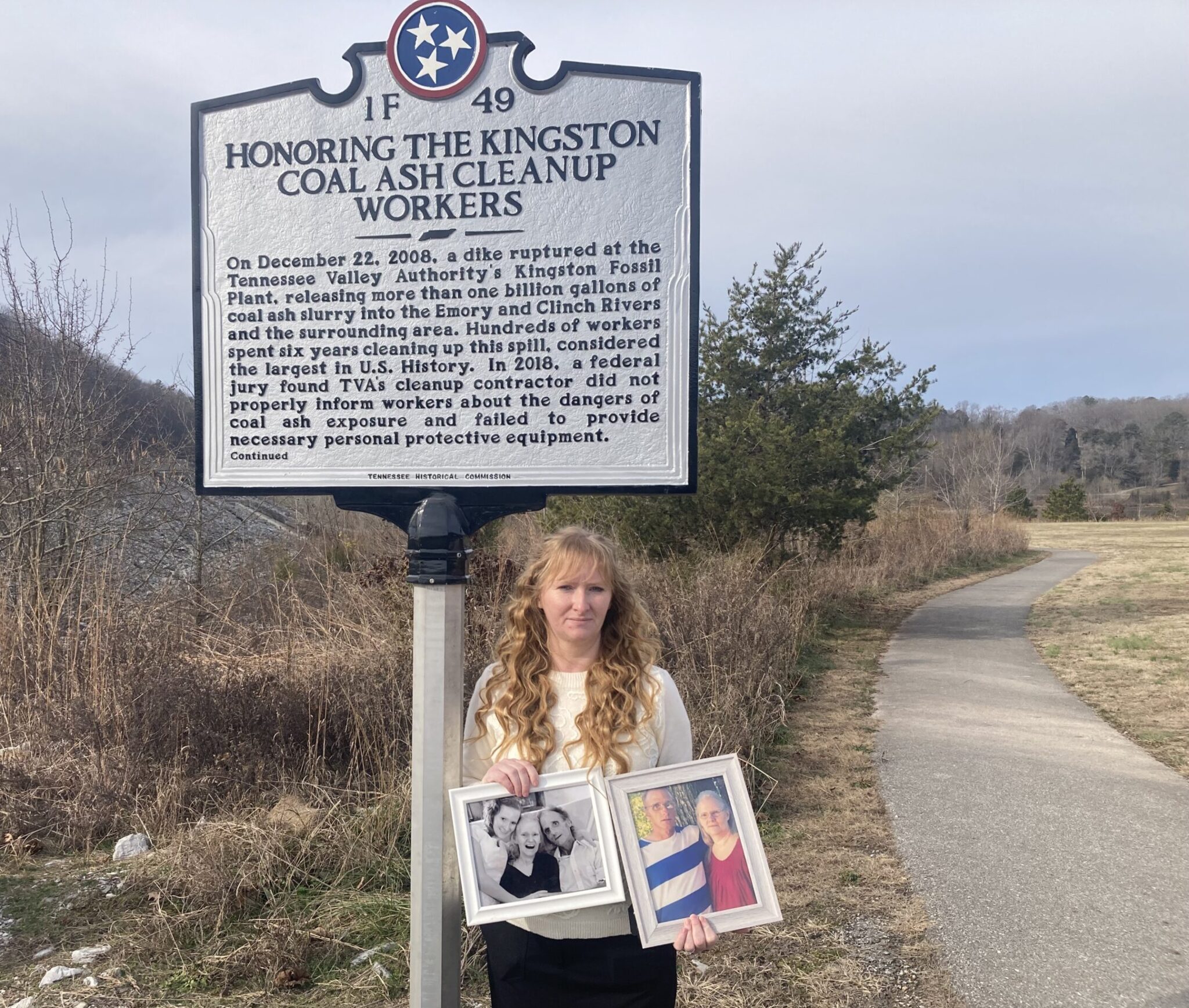
“This was all covered in the ash,” she said in December, pointing to soccer fields near a historic marker in Swan Pond Sports Complex at the former spill site.
Close to the 17th anniversary, Waller placed her parents’ portraits next to another nearby monument, a cross meant to represent those including her parents, killed by toxins.
She is still worried about contaminants still in nearby bodies of water, and her grief flares near the holidays.
“I do have a hard time with Thanksgiving and Christmas,” Waller said. She still decorates a tree on Nov. 1 like her mother, whose favorite holiday was Christmas, did.
She remembers her father making drawings using his computer’s “basic paint program,” including one that included an image of the Earth describing Jacobs and another company, Bechtel, as doing “environmental cleanup around the globe.”
Waller didn’t conclude the ash was a cause for her parents’ illness until after her mother’s death. Then she went on a “binge” of research on ash toxins. She connected with Janie Clark, whose husband had worked on the spill cleanup and died.
Waller met more spill workers and their families through a Facebook group. She compared her parents’ experience to that of others and then checked with doctors who’d treated other workers.
She said she got compensation from a lawsuit filed against Jacobs, settled in 2018 — Jacobs appealed the decision until 2023 — although she said the plaintiffs were “let down” by how long it took. Since then she’s told her story as a way to handle her grief he’s told her story for two years which she said helped her handle her grief for her parents and anger at TVA and Jacobs.
Waller said she hoped people could learn to be more skeptical of people in power and big corporations.
“Question everything,” she said, adding she likes to get second opinions in her nursing work.
Coal ash, she said, despite current talk of reviving the coal industry, is “definitely not safe” and that moving it around will “contaminate everywhere.”
She and Clark talk at least once per week.
“Nobody understands the type of grief that we are dealing with,” she said of herself and Clark. “We were the ones that witnessed the suffering.”