
“We facilitate the hiring process, and we also facilitate the science to allow all of our federal scientists to engage with the resources of the university, not only the people we work with at the Forest Service,” said Joel Snodgrass, head of the Department of Fish and Wildlife Conservation. “For the university, and especially for our students, we get this access to funding opportunities for experiential learning and opportunities for graduate student projects. It works a lot like most of the other embedded federal scientists that we have with us.”
Thousands of acres of national forest were damaged by Helene in Virginia, North Carolina, South Carolina, and Georgia. Most funding stems from damage in North Carolina, but the work spans the entire Southern Appalachian region.
The project aims to document, evaluate, and prioritize hurricane-related damage to aquatic and forest ecosystems. Field teams will assess entire watersheds, giving forest managers data to identify high-priority areas for remediation and plan interventions that restore ecological integrity, improve public safety, and support long-term forest health.
Colin Krause, a fisheries biologist at the Center for Aquatic Technology Transfer, said initial work will focus on North Carolina and Virginia.
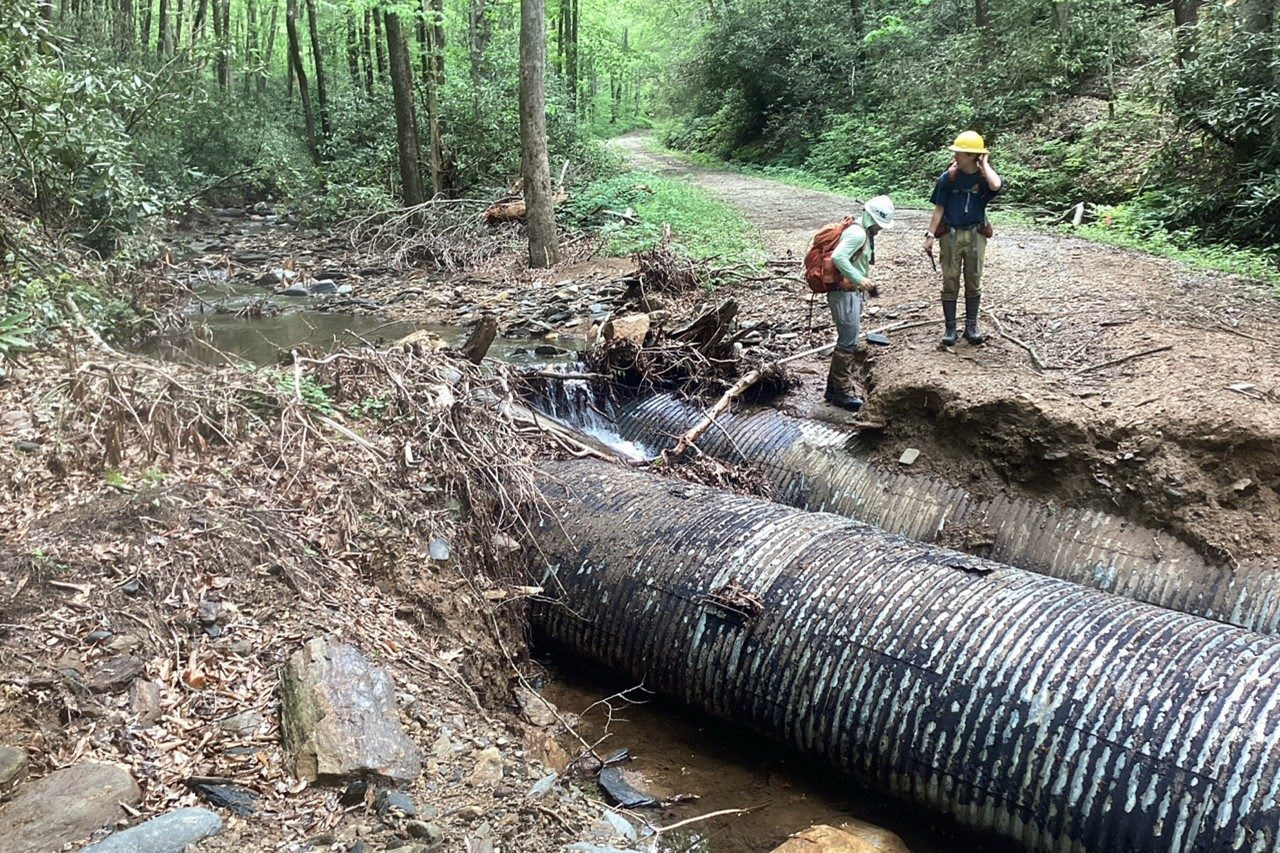
“The teams are going to be focused initially on storm damage assessments, where the teams are able to walk the entire lengths of streams within watersheds, on Forest Service lands, trying to find out where these damaged feature locations are,” Krause said. “They're looking for damaged items. They're looking for sites that are damaged or under the threat of damage, such as things like ecological integrity and forest health, or things that might impact human life or health.”
Field teams will carry out a wide range of assessments and monitoring tasks, including:
- Storm damage assessments: Walking stream corridors and watersheds to identify damaged or at-risk sites such as landslides, debris jams, channel diversions, hazardous material spills, or threats to infrastructure and forest health
- Road–stream crossing surveys: Evaluating culverts, bridges, and fords for aquatic organism passage and resilience to high-flow storm events
- Stream habitat inventories: Measuring riffle-pool ratios, sedimentation, water depth, and large woody debris
- Fish sampling: Using backpack electrofishing to document fish presence and community structure
- Environmental DNA monitoring: Detecting cryptic or threatened species such as the eastern hellbender, that are not easily captured with traditional methods
- Riparian and upland assessments: Identifying erosion, blowdowns, and slope failures
- Post-remediation evaluations: Measuring effectiveness and resilience to future storms and ecological recovery
The partnership creates robust opportunities for students. Many technicians hired are recent graduates or current students from the Department of Fish and Wildlife Conservation, part of the College of Natural Resources and Environment. They receive hands-on field training, work alongside federal scientists, and build networks that often lead to careers in conservation and resource management. Over half of the program’s employees in recent years have been Virginia Tech alumni or students.
The project will begin with intensive fieldwork in 2026 to gather baseline data. Later phases will focus on targeted assessments, data analysis, and remediation evaluations. By 2030, the Forest Service plans to have a comprehensive record of storm impacts and strategies for building resilience into forest ecosystems.
Beyond its immediate goals, the initiative underscores how large-scale grants advance science, improve public lands, and enrich student training, and the Forest Service partnership exemplifies the university’s land-grant mission: applying research to solve pressing challenges while preparing the next generation of conservation leaders.