
“We need to desperately preserve our natural areas,” said Planning Commissioner and Oak Ridge Mayor Pro Tem James Dodson, who made both motions.
Earlier, however, Oak Ridge planner Travis Estep explained that the original plan showed residential development as a possibility for both locations due to the city’s current housing shortage. He said that far more people work in Oak Ridge than live in it, and they use its services without giving the city as much revenue as permanent residents.
“There is no amount of infill that can compensate for the deficit of housing that we are already operating under,” he said. “I don’t know how else we can meet the needs of the community.”
Oak Ridge resident Don Barkman, who has spoken at length about these areas on social media and elsewhere, did not speak at the meeting, although Planning Commissioner Jane Shelton said she’d received a message from him.
Barkman told Hellbender Press he saw in ED-6 an opportunity for nature-related industry or a park, specifically on its Roane County side. He said Roane County lacked parks and that the comprehensive plan paid little attention to the city’s Roane side.
“It’s virtually devoid of anything to do with the Roane County side of the city,” he said, adding the only city park in Roane County is Big Turtle Park.
“I’m going to throw my hat in with the people who say ‘let’s keep that natural,’” he said of ED-6, citing its existing trails and an open understory forest of 60- to 70-year-old trees.
“It’s very placid back there, once you get in the middle section of it,” he said, adding that he would like to see the area continue to be preserved “25, 50, 100 years from now.”
Regarding the Three Bends area, he cited an agreement with former Secretary of Energy Bill Richardson. He said the unamended draft of the comprehensive plan, allowing for development in the Three Bends area, would have violated the agreement.
“It’s ‘honor agreements to their convenience’ is what it is,” he said, describing the city’s approach.
Like some who commented at the meeting, he said the city needed to put new housing within already developed areas of the city before branching out into areas like Three Bends or ED-6. He pointed out these areas have infrastructure to support new developments in ways wild areas don’t. He said the urban center of town, for example, could support new apartments. It is instead, Barkman noted, the site of yet another new car wash.
Such development patterns make it hard to parse the city’s development intent. “It doesn’t engender a whole lot of trust,” he said.
The previous story continues below:
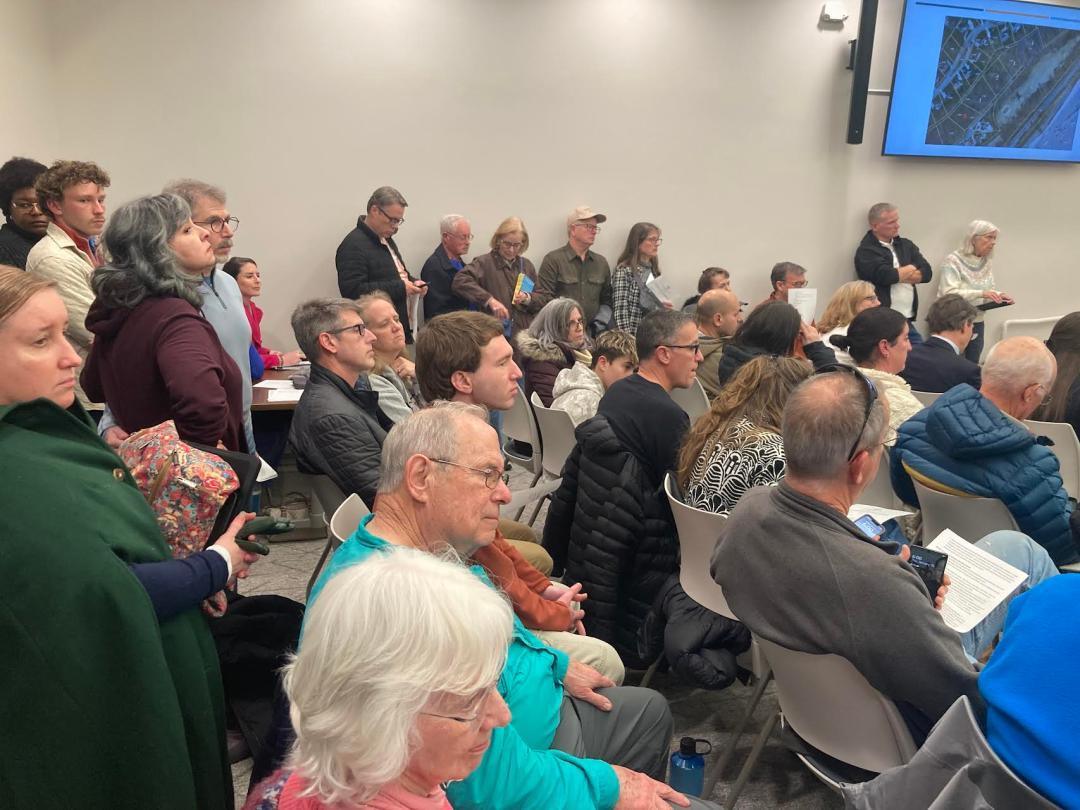
OAK RIDGE — A crowd of city residents filled the Oak Ridge Municipal Courtroom with a message for the Planning Commission: Keep a parcel in West Oak Ridge a wooded park.
Oak Ridge Planning and Development Director Jennifer Williams described the relevant land in a memo as containing about 336 acres adjacent to the Westwood subdivision. It’s currently federal Department of Energy land, but the city of Oak Ridge has formally requested its transfer to the city. It contains three mountain bike trails and a portion of the North Boundary Trail.
Williams told people at a Jan. 15 meeting of the Oak Ridge Municipal Planning Commission, however, it is not connected to the North Ridge Trail as she said some believed, which is a different trail in East Oak Ridge. Williams said that the parcel connects the neighborhood to the Lambert Quarry and Black Oak Ridge Conservation Easement (BORCE) but doesn’t directly include those areas.
The Planning Commission met to discuss principles for the land’s future if the city acquires it. A draft included principles stressing the value of conservation, but also a desire for housing and possibly even commercial development. Even at this early stage, concerns about the land’s future led to a standing-room-only crowd with speaker after speaker opposing residential or commercial development on the parcel. Planning Commission voted instead to further discuss the principles at a non-voting work session set for 5:30 p.m. Thursday, Feb. 12.
“There is no development actively proposed for this property,” Williams said. She said the city needed, however, to do “in-depth analysis” of any federally owned property it acquired, which she said the principles reflected.
The draft principles the city planning staff presented to the Planning Commission were as follows:
1. The plan should be a model for development and incorporate conservation principles.
2. The plan must respect and protect adjacent neighborhoods.
3. The plan must respect and protect the natural beauty and ecological value of Lambert Quarry and the BORCE, and should enhance connectivity to the BORCE for nearby neighborhoods as well as the general public.
4. The plan will evaluate an appropriate zoning designation(s) for the site.
5. The plan must analyze land use and infrastructure needs for the site and will include housing as an acknowledgment of the City’s need for additional housing, as well as quality commercial/mixed-use development to support the west end.
6. The plan should consider housing for different sectors of our population rather than a single segment of the population.
7. The plan should place an emphasis on community input from all areas and segments of the community including the surrounding neighborhood as well as those who desire to locate in Oak Ridge who have been unable to locate housing.
8. The plan should follow the proposed Comprehensive Land Use Plan
9. The plan should follow Blueprint Values and Goals:
a. Appreciation, expansion and access to our natural assets.
b. Growing our population in an economically sustainable way
c. Enhancing our image and quality of place d. Improve connectivity and mobility.”
Citizens who spoke at the meeting stressed the importance of keeping the area preserved in its current state, with several saying they believed that the city should only use the first three of these principles and leave out the rest of them. Still others stressed that the city had other areas to develop instead. Commenters represented a wide range of people from children to seniors. Most were Oak Ridge residents. Some spoke of how much they enjoyed the trails, while others spoke of conservation and wildlife.
Among the Oak Ridge residents who spoke was Robert Kennedy, a member of the city’s Environmental Quality Advisory Board, but also a resident of the nearby Westwood neighborhood, a member of the Westwood Association and self-proclaimed “tree hugger.”
“We’re here to talk about principles,” he said. “Well, the greatest ecological principle is that the whole is greater than the sum of its parts.” He said he’d prefer the city not cut a wild ecosystem into pieces but instead develop other vacant parcels elsewhere in the city.
“Don’t monkey with the life-support system,” he said. “That is what these natural areas are for all of us.”
He also said that the Tennessee Department of Environment and Conservation had calculated the recreational value of the adjoining officially protected Black Oak Ridge Conservation Easement at about $100,000 per acre, or $300 million total. He said the parcel in question would increase that value by at least 10 percent.
Another speaker with a distinctive perspective was owner of The Houndry, Amanda Lovegrove. Her business involves walking dogs on Oak Ridge’s forest trails.
“A large portion of our work depends directly on this greenway,” she said of the trails on the property in question. She said these and other trails in the west gave pet owners “an option that doesn’t exist almost anywhere else on that side of town.” She said the development in the area would hurt her business.
“It wouldn’t just change our routes,” she said. “It would fundamentally affect our ability to operate.” She also said the area protects wildlife that has “fewer and fewer safe places to go.”
Planning Commissioner Charlie Hensley said he worried about whether the city and developers would even follow any set of principles.
“We’ve had principles in the past, but what always happens is that the principles shrink,” he said.
“All these very sincere people have moved the needle for me,” he said after the comment period and before the vote to further discuss the principles rather than approving them that night.
City gives more details
The city of Oak Ridge staff gave more details about its possible plans in a Facebook post in response to the comments, and provided more information on its website. It stated “unequivocally that any city-generated plan would include an unchanged North Boundary Trail at the top of Wisconsin that continues to be connected down to an area on the Oak Ridge Turnpike,” that there would still be a connection to Lambert Quarry, and that the city would include a wild buffer area between the trail and development, although the city did not give that buffer’s size. It also stated the city might give the trail a paved parking area with restrooms.
It did, however, state that the city had discussed other types of development for other parts of the parcel.
“While the city is in the early phases of evaluating potential uses, discussions have included much-needed housing that matches the lot sizes and character of the existing neighborhood at the top of the parcel — as well as more dense development, such as townhomes or apartments, and the potential for a school at the bottom of the parcel along the Oak Ridge Turnpike,” the city stated.