
Ben Pounds
Updated: Oak Ridge shelves planning vision after citizen pleas to preserve natural areas
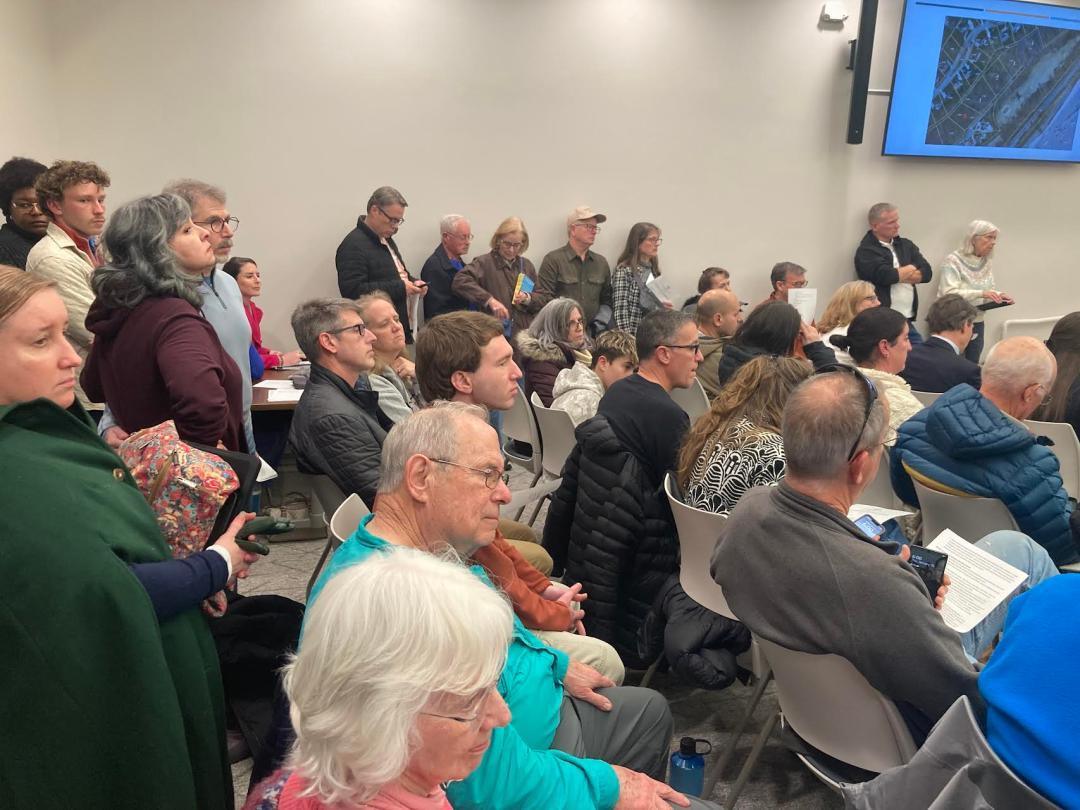 A standing-room-only crowd implored the Oak Ridge Planning Commission on Jan. 15 to preserve a forested tract on the west end of the city for its recreational and cultural values. At it’s next meeting, the commission backpedaled on its comprehensive plan. Ben Pounds/Hellbender Press
Board backtracks after public protests consideration of development of forested West Oak Ridge parcel and Three Bends area in the east
OAK RIDGE — After intense public pressure, the Oak Ridge Municipal Planning Commission backtracked on tentative planning proposals and recommended preserving two land parcels currently owned by the Department of Energy as parks or natural areas.
The votes, on Feb. 19, concerned a comprehensive plan the Planning Commission is developing as a general blueprint for the future of the entire city.
The Oak Ridge City Council will vote on it next. The plan does not establish formal zoning but rather a long-range guide for the type of development the city would like to occur in different areas. City planning staff had suggested residential development in two DOE-owned areas currently used for outdoor recreation. Those two areas were the Three Bends area on the city’s East Side, which is 3,000 acres along Melton Hill Lake including Clark Center Park. he ED-6 parcel on the city’s west side, which includes 336 acres adjacent to the Westwood subdivision. The latter proposal especially engendered public protest, with citizens packing a meeting room in January to voice their opposition.
The draft comprehensive plan originally suggested keeping most of the Three Bends area a park alongside some clustered development, including the possibility of 10-story apartment buildings. City Manager Randall Heman had discussed a school and residential developments in ED-6. Planning Commission amended the plan after many citizens cited the conservation and recreation values of the areas, and designated both areas for “nature and open space.” The changes came in two separate amendments, both of which passed.
17 years after TVA coal ash spill, pain lingers for families of cleanup workers
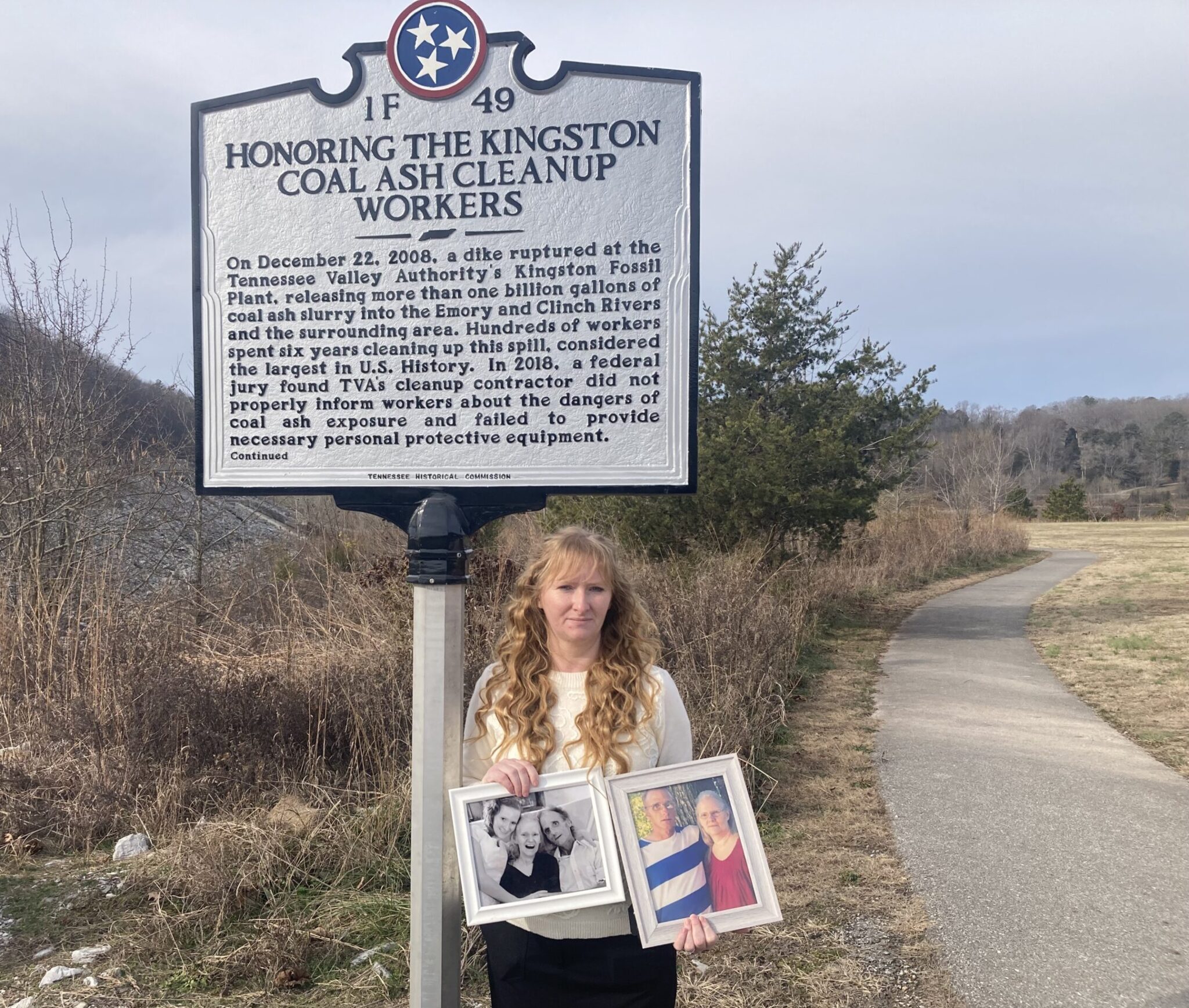 Jessica Waller, whose father worked on cleanup of a massive Tennessee Valley Authority coal ash spill, reflects on the effects of his work nearly 20 years after the spill. Benjamin Pounds for Tennessee Lookout
Jacobs Engineering required employees to work without personal protection in cleaning up toxic byproduct of coal burning; many died after the work.
This story was originally published by Tennessee Lookout.
HARRIMAN — Seventeen years have passed since a massive rupture at a Tennessee Valley Authority plant spilled more than 1.1 billion gallons of coal ash into Harriman, Tenn., but the event is still raw in Jessica Waller’s mind.
Waller’s father, Ernest Hickman, a union contractor for Jacobs Engineering Group, worked on cleanup of the spill.
Hickman died of emphysema, which Waller attributes to his contact with the ash over a six-year cleanup period — specifically beryllium, a naturally occurring metal used in the nuclear, automotive and aerospace industries; and arsenic, which is used in metal, technology and some medical uses.
Both are present in coal fly ash and are highly toxic.
She believes her mother, Patsy Hickman, also got ill from exposure after washing her husband’s clothes and other activities putting her in contact with the ash, causing her death of respiratory failure.
“It’s sad to know there’s a lot of people even here in Tennessee in the area who have no idea about the coal ash spill,” Waller said. “Or they do but they didn’t know the extent of the devastation that it caused, especially health-wise of making so many people sick.”
Land donation protects Obed-area wildlands on eastern fringes of Cumberland Plateau
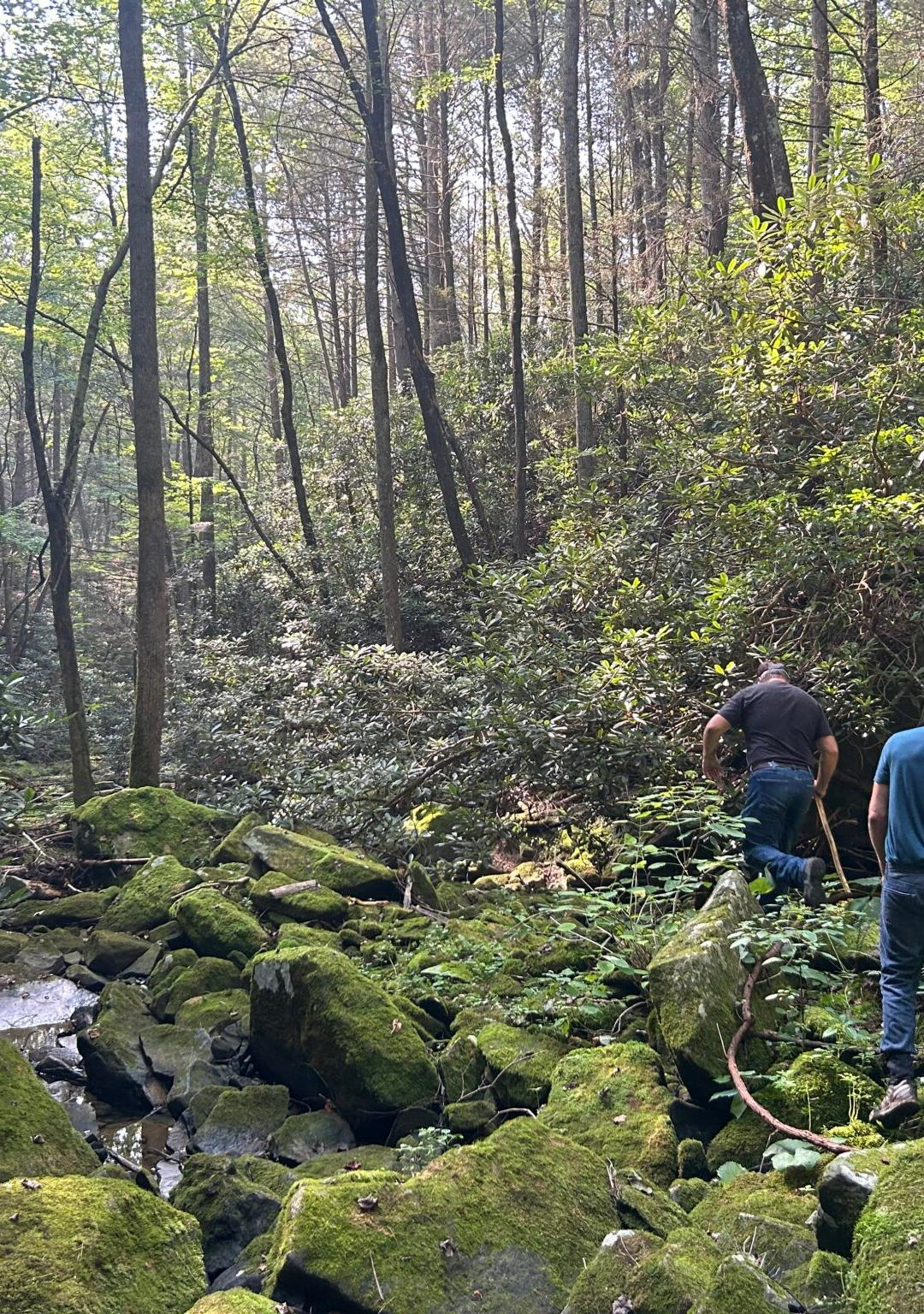 Hikers walk along Ramsey Creek during a dry time. Tennessee Citizens for Wilderness Planning has assembled land to be turned over to the National Park Service to expand public lands at the Obed Wild and Scenic River. Chuck Estes/Tennessee Citizens for Wilderness Planning
There’s more room to roam in the Cumberlands thanks to Oak Ridge-based citizens group
WARTBURG — As East Tennesseans and tourists alike enjoy summer fun on the wild Obed River, enthusiasts are growing its amount of federally protected land.
Part of the U.S. National Park Service system, the Obed Wild and Scenic River in Cumberland and Morgan Counties on Tennessee’s Cumberland Plateau offers swimming, hiking, picnicking, kayaking, fishing and climbing at the federally protected park. It currently includes about 45 miles along streams like the Obed and Emory Rivers.
Residents of Oak Ridge, a little less than an hour’s drive away, created Tennessee Citizens for Wilderness Planning (TCWP) and lobbied to create the federally protected area in 1976. Now, the same group, through fundraising and land swaps with anonymous private individuals, has gained 30 acres on which it plans to build a trail connected to the federal land.
- obed national wild and scenic river
- tennessee citizens for wilderness planning
- tennessee land preservation
- cumberland mountain quail
- cumberland plateau
- cumberland hiking
- new hiking trails in east tennessee
- hiking in tennessee
- recreation
- fishing
- kayaking
- climbing
- ramsey creek
- national park service
- hellbender
- citizen action
Dust to dust: Bull Run stack hits the deck as TVA kicks coal to curb
 The regionally famous Bull Run smokestack was demolished this summer by the Tennessee Valley Authority as the federal utility phases out the use of coal to generate electricity. Climate activists are alarmed by TVA’s plans to replace coal with natural gas, itself a powerful greenhouse gas pollutant. Tennessee Valley Authority
What’s next for mammoth utility after demolition of Claxton, Tenn. landmark stack?
CLAXTON — In a matter of seconds, the old smokestack fell like a giant tree, heaving clouds of dust as it hit the ground. Workers set off the implosion with a loud boom at the base of the towering smokestack on June 28, at Bull Run Fossil Plant just outside of Oak Ridge. Minutes earlier, the shorter and more modern ‘scrubber’ bit the dust in similar fashion.
Updated 2/28: Energy secretary on visit to an uncertain Oak Ridge shrugs at climate change; offers little concrete update on federal cuts
U.S. Sen. Bill Hagerty, R-Tenn.; U.S. Secretary of Energy Chris Wright; Rep. Chuck Fleischmann; R-Chattanooga; and Open AI CEO Greg Brockman spoke with the press during a tour of Oak Ridge-area nuclear facilities. Ben Pounds/Hellbender Press
Visit by energy secretary doesn’t address program cuts as former fracking CEO downplays climate change threat; visit comes following diversity program cuts; full extent of Oak Ridge impacts still unknown
Hellbender Press typically avoids the use of anonymous sources. The sources in this story spoke on condition they not be identified so they could speak on a sensitive matter.
This story will be updated. The original stories continue below.
OAK RIDGE — U.S. Secretary of Energy Chris Wright denied that climate change was a “crisis” and downplayed its threat during a visit to an international hub of scientific expertise rattled by early actions of the second Trump Administration. His visit did little to allay fears of cuts to staff and programs at Oak Ridge National Laboratory, where the most concrete signs of change have been the dismantling of diversity efforts.
Wright visited ORNL on Feb. 28, and at a press conference defended the Trump administration’s actions on climate change, energy sources and the Department of Government Efficiency (DOGE), a group headed by Elon Musk that has recommended cutting programs and staff in various government departments.
He did not announce any layoffs at the lab itself, however, and implied research related to climate there will continue. Oak Ridge National Laboratory is home to many kinds of related research, including at the Climate Change Science Institute. CCSI does modeling and gathers data on the climate, as well as working on solutions to the problem.
Wright promoted research on artificial intelligence, which he called “Manhattan Project II,” and nuclear energy, and he appeared alongside Sen. Bill Hagerty, R-Tenn., Rep. Chuck Fleischmann R-Chattanooga and Open AI CEO Greg Brockman, who also spoke and answered questions.
“I don’t think you’ll see any reduction in the science that we do regarding climate change or any of these other really big questions,” said Wright in response to a reporter’s questions about how cuts at the lab might affect climate change-related research at ORNL, which his department funds through a partnership with contractor Battelle and the University of Tennessee. He said, however, he still “100 percent” believed there was no climate “crisis” and said scientific reports backed up his view.
“We haven’t seen an increase in the frequency or intensity of hurricanes, floods, droughts, storms. Wildfires are on an uptick because we stopped managing our forests,” he said. “Deaths from extreme weather, which is what you hear the press and politicians’ fearmongering about, it declined over 90 percent in my lifetime as the population’s grown. So climate change is a real phenomenon. It’s just not even remotely close to the world’s biggest problem.” He also said an intergovernmental climate change report also showed economists saying climate change was not as important as issues like education, free trade and “empowerment.”
These claims are a mixed bag of truth. While the frequency of hurricanes hitting the United States, for example, hasn’t increased, a recent Columbia University study showed the tropical cyclones’ intensity for the East and Gulf Coasts has. Also unmentioned by Wright was any impact the climate has on disease or health conditions apart from extreme weather, a subject on which experts at Tennessee’s own Vanderbilt University have sounded the alarm.
Wright was CEO of a hydraulic fracking company, Liberty Energy, before his appointment.
“It’s a real thing, but nothing in the science of climate change or in the economics of climate change shows it to be the world’s biggest problem,” Wright said. “When you call something a crisis, it means we don’t have time to stop and think. We’ve just got to take action. That’s exactly the opposite of what climate science is.”
During the meeting, he also defended Musk, DOGE and Trump’s actions generally while not announcing any such cuts for the civilian research at Oak Ridge National Laboratory or the weapons maintenance at Y-12, which is managed by a different contractor. A reporter at the event mentioned an earlier instance in which workers at Y-12 National Security Complex received termination letters that were then rescinded. While the reporter asked him to offer reassurance on job security, he sidestepped that question.
- doge oak ridge
- doge cuts in oak ridge
- oak ridge national laboratory climate change institute
- did oak ridge get doge cuts
- trump and environment
- ornl jobs
- ornl employee meeting
- doe diversity
- doe office of science
- stephen streiffer
- inflation reduction act clean energy
- doe science focus
- ben pounds
- ornl source
- climate change
- is climate change real?
- chris wright
- energy secretary chris wright
- greg brockman
- open ai
Nukes hit Oak Ridge airport: Plans on hold in favor of private science enterprise
 Illustrated photo from a presentation on the Oak Ridge Airport project to Roane County officials at the Roane County Courthouse in Kingston on Thursday, Dec. 7, 2017 soon after the state appropriated $15 million for use toward the now-paused airport project. Roane County via Oak Ridge Today
City: Airport ‘paused’ because of nearby planned uranium-enrichment facility
OAK RIDGE — The city paused its long-simmering and controversial project to build a general aviation airport in the western part of Oak Ridge.
Oak Ridge government announced it paused the plan to build the airport in part of East Tennessee Technology Park because another nearby project is going forward: Orano USA’s Project Ike. Orano announced its plans for that project, a large uranium enrichment facility, Wednesday, Sept. 4; the city of Oak Ridge announced its pause the following week, Wednesday Sept. 11.
The city stated it wanted to “re-evaluate the proposed location” for the airport due to the Orano plan. City communications specialist Lauren Gray declined to name any other locations the city might be considering, saying plans weren’t that definite yet.
(Hellbender Press won a first-place award from the East Tennessee Chapter of the Society of Professional Journalists for its previous coverage of the proposed Oak Ridge airport).
Contractors finish scraping remnants of war industry at former K-25 site in Oak Ridge
 Aerial view of the East Tennessee Technology Park in August 2024 following the completion of all demolition and soil remediation projects at the former uranium enrichment complex by DOE’s Oak Ridge Office of Environmental Management and contractor UCOR. Department of Energy
Final remediation could add spark to regional technology and alternative-energy industry
OAK RIDGE — Workers finished clearing more than a million tons of nuclear-contaminated soil from a long-toxic site in the Atomic City dating to the World War II and Cold War eras.
While the site was established to enriched uranium for the atomic bomb the U.S. dropped on Hiroshima toward the end of WWII, its future may lie in solar power and peaceful use of nuclear technology. The cleanup also ties into broader questions and controversies about storage of wastes from other Oak Ridge sites.
The U.S. Department of Energy’s (DOE) Oak Ridge Office of Environmental Management (OREM) and its contractor United Cleanup Oak Ridge (UCOR) removed and disposed of more than 554,000 cubic yards of soil, equaling nearly 50,000 dump truck loads, according to OREM.
“Today is a significant and meaningful step toward completing our ultimate mission at the East Tennessee Technology Park,” said OREM Manager Jay Mullis. “Our progress has transformed the site from an unusable liability into an economic asset for the Oak Ridge community.”
 Ed Blandford, Kairos Chief Technology Officer, chats with Oak Ridge Environmental Management’s Ben Williams after an event celebrating the cleanup of radioactive soils at Oak Ridge’s K-25 site. Ben Pounds/Hellbender Press
Nancy Manning is putting in the work for seven generations
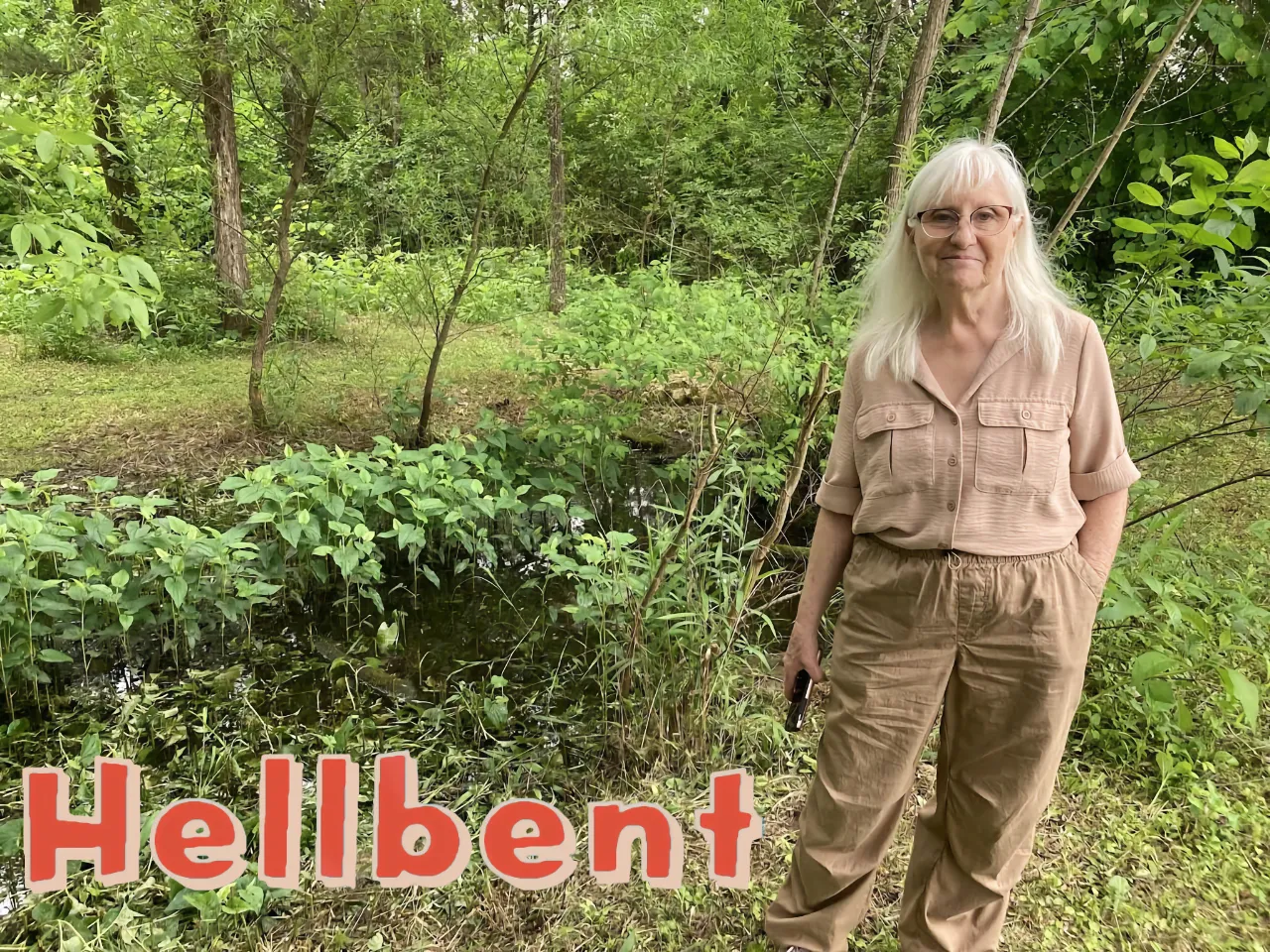 Tennessee Citizens for Wilderness Planning Executive Director Nancy Manning stands in a wetland in the Oak Ridge Cedar Barrens. She is cultivating a project that involves students from nearby Jefferson Middle School. Ben Pounds/Hellbender Press
New TCWP director already helping our kids ‘Explore and Restore’
OAK RIDGE — The students looked for tiny animals, tested water samples and took careful note of plants. Their recorded observations of Oak Ridge Cedar Barrens, a state natural area, were part of their class at the adjacent Jefferson Middle School (JMS), but volunteers from many outside organizations helped them with their scientific processes. They joined the students on the side of a wetland as they walked through the tall native grasses beneath the red cedars that give the small protected area its name.
Among these volunteers was new Tennessee Citizens for Wilderness Planning Executive Director Nancy Manning. Manning became TCWP’s chief operating agent Aug. 1 of last year, succeeding Sandra Goss after they worked together for a month. Centered in Oak Ridge, TCWP has a storied history preserving and maintaining not just the small Oak Ridge Cedar Barrens area but also Obed Wild and Scenic River and Big South Fork National River and Recreation Area. While Manning is continuing that work, she’s put a special focus on fighting “nature deficit disorder” a term credited to Richard Louv and his book Last Child in the Woods.
The phrase refers to a lack of direct experience with nature, and Louv tied such a deficit in his 2005 book to psychological disorders and obesity. So Manning conceived the “explore and restore” program, which gives students a chance to both study and maintain natural areas, and brought it with her from Texas to Tennessee.
- tcwp
- tennessee citizens for wilderness planning
- nancy manning
- travis audobon
- oak ridge environmental issues
- oak ridge airport
- oak ridge nuclear waste dump
- oak ridge cedar barrens
- obed
- big south fork
- nature deficit disorder
- last child in the woods
- jefferson middle school science
- red cedars east tennessee
- julie mccollough teacher oak ridge
- leonard peltier
- hellbent
All-access passes enabled in Smokies: “This national park belongs to you”
 Vicky Wallace gets assistance crossing a creek in her off-road GRIT wheelchair during an adaptive camping outing along Cooper Road Trail in Great Smoky Mountains National Park. Yvonne Rogers/Hellbender Press
Adapted to their environment, wheelchair users venture into Smokies backcountry
TOWNSEND — Four wheelchair users ventured this month to an Abrams Creek backcountry campsite in a first for the Smokies.
Borne by GRIT Freedom Chairs, the able trekkers arrived June 8 in a collaborative event featuring Great Smoky Mountains National Park, Knox County, Kampgrounds of America Foundation and Catalyst Sports. The intrepid group had headed up about a mile of the wide, gravel Cooper Road Trail over hills toward Campsite 1, past horses, along and through streams, finally reaching their campsite. The three-wheeled, arm-powered GRIT chairs are designed for off-road routes.
For much of the route the adaptive hikers used their arms to move their chairs, but other people accompanied them on foot, sometimes helping them up difficult hills or over streams. Those in the chairs enjoyed the mountain water that rushed over their feet.
Park Ranger Katie Corrigan talked about highlights of the natural world around them and led discussions on the concepts of wildness and wilderness. Just like many other backcountry campers, the group of adventurers ate s’mores and slept in tents at the campsite before heading back down Cooper Road to the trailhead the next day.
- carly pearson
- park ranger katie corrigan
- grit freedom chairs
- cooper road trail
- great smoky mountains national park
- abrams creek
- campsite 1 smokies
- kampgrounds of america foundation
- catalyst sports
- daniel penley
- kaitlyn lengel
- vicky wallace
- americans with disabilities act coordinator for knox county
- adaptive sports
- adaptive recreation
- adaptive kayaking
- adaptive recreation smokies
- disabled access
- disabled access to outdoors
- people with disability
- accessibility
- people with limited ability
- adaptive program
Resisting the alien invasion: Oak Ridge work party highlights threat of invasive plants
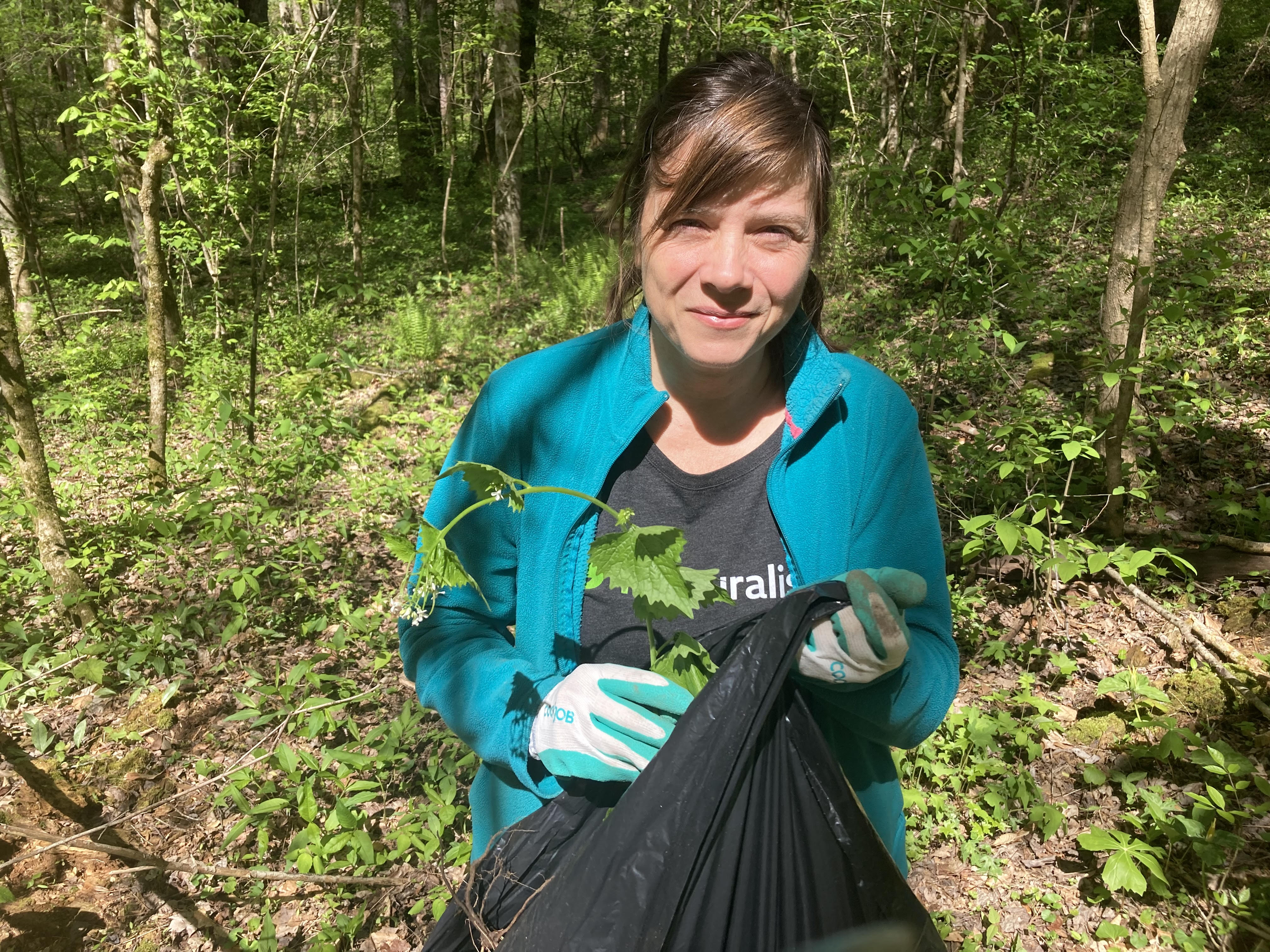 Regina Santore with the Wild Ones Smoky Mountains Chapter puts garlic mustard into a bag during an April volunteer event along a greenway in Oak Ridge. Ben Pounds/Hellbender Press
Volunteers fight exotic and invasive garlic mustard on Oak Ridge greenway
OAK RIDGE — Plants from around the world are overrunning the Southeast’s wild places, causing problems for native flora and fauna.
It’s a problem that’s grabbed the attention and work of dedicated organizations. One of them, the Tennessee Invasive Plant Council has many strategies to solve this problem: volunteer weed-pulling events, guides to help gardeners find native plants from which to choose, and even legislation. Its vice president, Jamie Herold, has many thoughts on the issue. She was eager to share them over pizza after a morning of pulling one such invasive, garlic mustard, at an event in Oak Ridge organized by Tennessee Citizens for Wilderness Planning, and Greenways Oak Ridge.
The event involved pulling garlic mustard, a plant originally from Europe, from the edge of the woods behind apartments on West Vanderbilt Avenue. This area includes the Wildflower Greenway, a trail full of wildflowers that locals have been eager to protect from the garlic mustard’s domination.
- exotic invasive
- exotic species
- invasive plants
- invasive plant control
- invasive species
- oak ridge greenway
- garlic mustard
- tennessee invasive species
- tennessee invasive plant council
- jamie herold
- regina santore
- roger macklin
- wildflower greenway
- tennessee citizens for wilderness planning
- greenways oak ridge
- wild ones smoky mountains chapter
- biodiversity