
Thomas Fraser
Fly, flit, buzz, flutter or soar over to Ijams Nature Center this weekend for its Hummingbird Festival and Celebration of Wings

Bats, birds and all winged creatures are the guests of honor at Ijams Nature Center in Knoxville this weekend.
The center plans a celebration of science and our flighty friends from 7 a.m. to 2 p.m. on Saturday.
The educational event is open to all ages and will feature bird-banding demonstrations/projects; food trucks; guided walks; expert speakers; arts and crafts; and a chance to meet a number of raptors and animals native to East Tennessee. Citizen science demonstrations will show how anyone can contribute to the study and conservation of our natural world.
You can get tickets online for the Hummingbird Festival and Celebration of Wings.
The 2021 Ijams Hummingbird Festival: Celebration of Wings is sponsored by Ergon Terminaling Inc., The Trust Company of Tennessee, WBIR-TV Channel 10, HomeTrust Bank, Stanley's Greenhouse, and Tennessee Wildlife Federation.
Tennessee Theatre latest major venue to require vax proof or test result for entry
The Tennessee Theatre announced Monday it will require proof of inoculation against Covid-19 or a recent negative test for the virus before entry into the historic, storied theater on Gay Street in Knoxville. The theater will also require that all audience members be masked. The new rules are effective immediately.
The theater said in an email that increasing rates of infection in the Knoxville area and elsewhere in the country — predominantly in the Southeast — prompted the public-safety decision.
”Because of this, the Tennessee Theatre is enacting some new (Covid) protocols to allow us to continue presenting events while doing our best to keep our audiences safer and healthier.“ The rules will be in place at least through Halloween, according to the theater.
”While we take these necessary steps to remain open and serving the community while providing a safer environment for all, we ask for patience and understanding as we continue to navigate a challenging period in the Tennessee Theatre’s 93-year history.”
The negative test must have been administered within the preceding 72 hours.
Some upcoming shows and events at the Tennessee Theatre into October include this week’s screening of the Goonies; three Knoxville Symphony Orchestra Masterworks Series performances; the Righteous Brothers; and an Alton Brown appearance.
State’s fight against Asian carp scales up
WATE: Commercial fishing pulls out 10 million pounds of exotic carp from Tennessee River system
If you never thought there’d be an Asian carp commercial fishery in Tennessee waters, you were wrong.
Tennessee Wildlife Resources Agency’s Asian Carp Harvest Incentive Program has yielded 10 million pounds of the exotic fish since 2018, the bulk caught downstream on the Tennessee River system at Kentucky and Barkly reservoirs. The fish has been spotted as far upstream as Knox and Anderson counties.
The Tennessee Valley Authority and TWRA are experimenting with acoustic barriers to prevent further upstream spread of the fish, which compete with native fish for food and habitat.
“There are four types of Asian carp: bighead, silver, black and grass,” WATE reported. “Experts say the species threatens to disrupt aquatic ecosystems and starve out native species due to their ability to out-compete native species for food like plankton.”
So what do fishermen do with 10 million pounds of carp?
It can be sold to wholesalers for distribution abroad and also makes for really good fertilizer.
Clean-energy advocates take demands to base of TVA towers and power
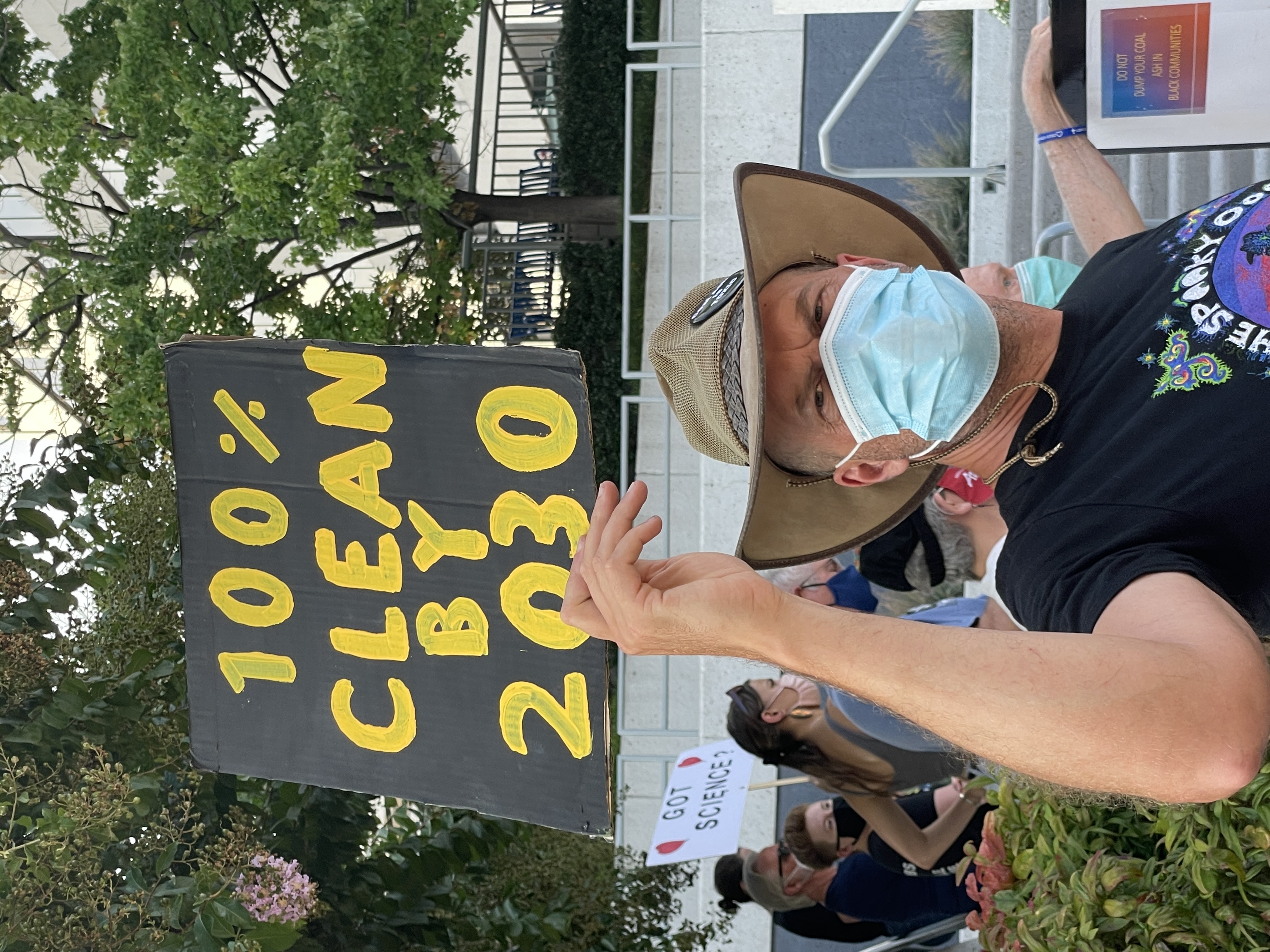 Alex Pulsipher holds a sign demanding that TVA transition to 100 percent renewable energy at a rally Wednesday in Market Square in Knoxville. Courtesy Amy Rawe/Southern Alliance for Clean Energy
Varied environmental groups offer unified plea for clean energy, coal ash management and accountability from TVA
It was people power generating energy at Market Square in downtown Knoxville on Wednesday.
A coalition of civic and environmental groups and their representatives met at the bottom of the two Tennessee Valley Authority towers urging the public utility to reopen meetings to public comment; swear off all fossil fuels by 2030; and carefully tend to the needs of those affected by coal ash and devise a plan to contain it for the safety of current and future generations.
- tva clean energy
- coal ash
- kingston coal ash spill
- southern alliance for clean energy
- kingston coal ash worker
- tva coal ash
- sunrise movement
- appalachian voices
- sierra club
- tennessee valley authority
- accountability
- public comment
- tva board meeting
- carbon reduction
- climate action
- carbon free by 2030
- renewable energy
Black bear killed man whose body was found by Hazel Creek in Great Smoky Mountains National Park
Rangers shot and killed bear eating body at campsite 82
(This story has been updated)
A black bear killed a man whose body was found by backpackers at a Hazel Creek campsite in September 2020.
Patrick Madura died “due to trauma caused by a bear,” according to a news release from Great Smoky Mountains National Park.
He would be only the second park visitor known to be killed in a bear attack in the 80-year history of the national park.
Glenda Bradley was killed in a predatory bear attack on the Little River trail in 2000. Two bears were shot and killed by park rangers after a Boy Scout troop came upon the incident. The animals, a sow and yearling, were eating and attempting to cache Bradley’s body when they were killed.
Madura’s body was found by backpackers arriving at campsite 82 on Sept. 11, 2020. They first noticed an empty tent, then saw a bear “scavenging” the victim’s body across the creek.
Rangers responding to the subsequent emergency call found a bear eating Madura’s body and shot and killed the animal. Hazel Creek Trail and the campsite were temporarily closed following the incident.
Madura, 43, of Elgin, Illinois was hiking and camping alone when he was attacked, according to the park service. No additional information about food storage issues or what may have precipitated the attack was immediately available from the park service.
Madura was an accomplished outdoorsman with a masters in biology and was trained as an EMT and firefighter, according to local reporting from the Chicago area following his death last year.
Fatal attacks are extremely rare, given the number of visitors to the national park, the most visited in the country. Nonfatal attacks, while still rare, are more common. A bear attacked a teenager as she slept in a hammock near the Maddron Bald trail in the Cosby area earlier this year; she was airlifted from the park with serious injuries but was expected to make a full recovery. The bear involved in that attack was euthanized as well.
Rangers urge visitors to be Bearwise, but regularly encounter improper interactions between bears and visitors, such as an incident this summer in which a woman was cited for feeding a bear peanut butter from a vehicle in Cades Cove.
Raise your voice for clean energy today in downtown Knoxville
Looking for something to do after work? Want to be part of a rising movement urging TVA to move away from fossil fuels in the face of the global climate crisis? Support transparency from the largest public utility in the country?
The Southern Alliance for Clean Energy, Appalachian Voices, Center for Biological Diversity, the Sunrise Movement, Sierra Club, and other local organizations are hosting a clean-energy rally from 6 p.m. to 7:30 p.m. today (Aug. 18) on Market Square near TVA’s headquarters in downtown Knoxville.
TVA hasn’t had a public listening session in over a year, according to rally organizers. Rally participants will demand that TVA:
— Restore public listening and input sessions;
— Commit to 100 percent clean energy by 2030;
— Not build new fossil gas plants;
— Protect coal ash workers, and;
— Dispose of coal ash properly with public health and safety as the utmost priority.
The rally will feature songs from local musicians, a reading of demands for TVA, speakers discussing pressing issues for TVA and our region, and a short march around Market Square.
Masks and social distancing are encouraged. For those unable to attend in person, a virtual option is available at Tennessee Valley Energy Democracy Movement Facebook page.
Scott Schlarbaum speaks for the trees and the future of Tennessee forests
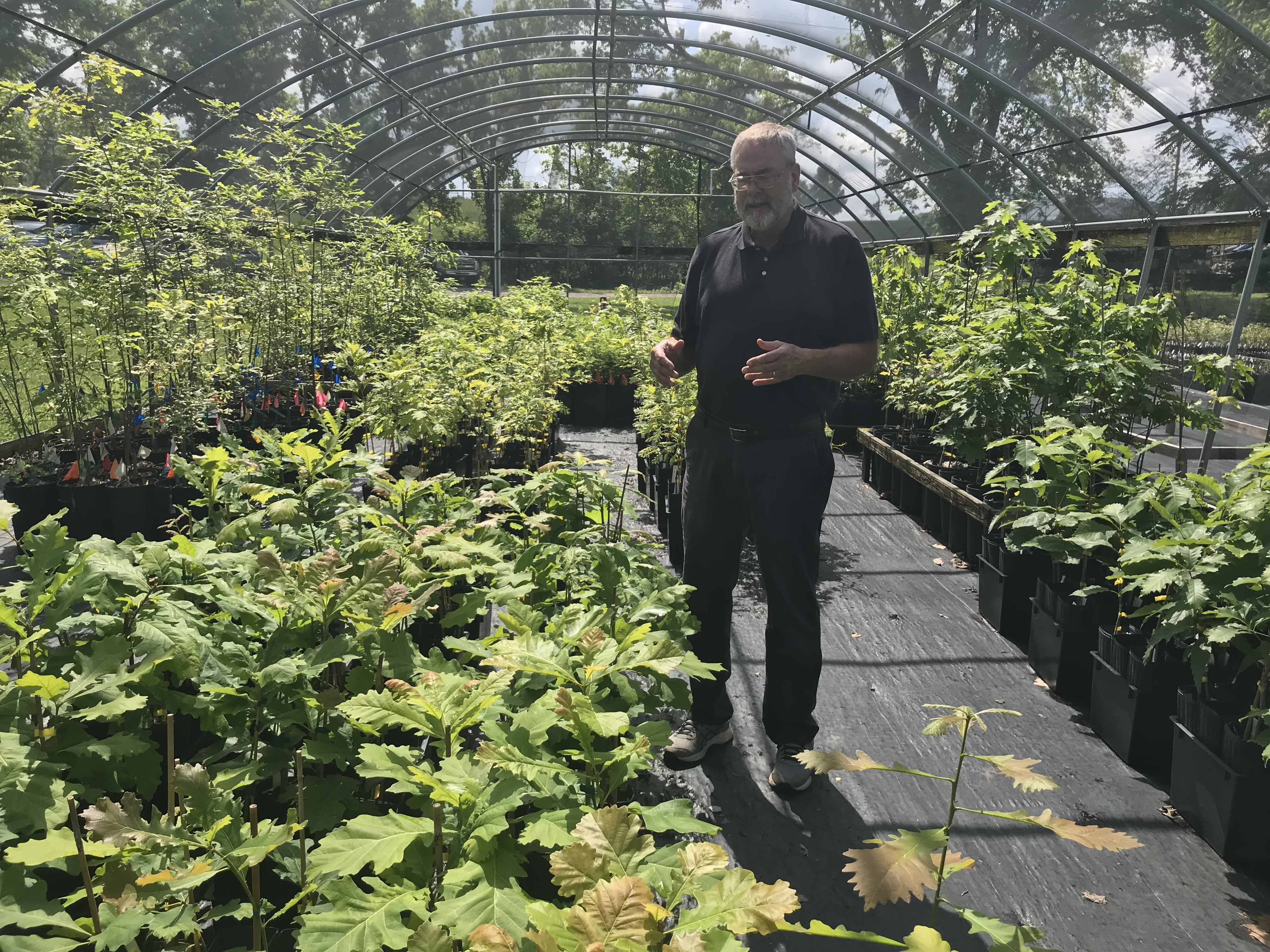 Tennessee Tree Improvement Program director Scott Schlarbaum stands among a collection of grafted and cloned native trees at the program’s grafting facility off Alcoa Highway. Thomas Fraser/Hellbender Press
2-minute video on hemlock genetic diversity conservation added to this article on September 2, 2021
UT Tree Improvement Program prepares for its greatest grafting season yet
“What you have here is the future of Tennessee forests,” said Scott Schlarbaum, a professor and director of the University of Tennessee Tree Improvement Program.
You can tell from a chuckle he thinks his statement might sound hyperbolic and a bit dramatic, but it’s really not.
He gestured across an unassuming but important UT facility just off Alcoa Highway tucked within the East Tennessee AgResearch and Education Center that will be the main base for a historic tree-grafting effort that will commence this winter.
The goal: Create trees with high-quality genetic traits ranging from wildlife and habitat qualities to timber value.
Heavy traffic hissed down the nearby highway as it passed by the modest understock yard, greenhouse, raised beds and small house containing offices used as the main grafting facility for the UT Tree Improvement Program (TIP). At least 50,000 vehicles pass by the site every day but most drivers and passengers are oblivious to the existence of this small but important outpost of forest conservation skirted by a Knox County greenway.
The Tree Improvement Program was first established in 1959. It survives as a notable exception to the cost-cutting of such projects in other states at both university and government levels.
“These days we tend to look only at the short term. UT did not.”
Beginning in January, Schlarbaum, director of the program since 1983, will oversee grafting efforts on some 3,600 trees. Last year, during which TIP efforts were disrupted by the Covid-19 pandemic, about 2,000 trees were grafted.
“We are gearing up for our biggest grafting year ever. That’s a huge deal,” Schlarbaum said.
In face of crushing drought, feds cut Colorado River water use for first time
NYT: Arizona farmers first affected but more cuts likely in future
The Bureau of Reclamation declared a water shortage Monday in Lake Mead, a huge reservoir below Hoover Dam that lies along the Colorado River, a historical, natural and national landmark and economic engine that ultimately provides water to seven Western states.
It was the first such dire Level 1 declaration since construction of the reservoir, the largest in the Colorado River impoundment system, in the 1930s. The surface of Lake Mead is projected to soon reach about 1,000 feet above sea level; it's only at about 35 percent capacity, the New York Times reported. Lake Powell in Utah is also at historically low levels.
In an example of drought affecting areas beyond the Colorado basin, a California reservoir, Lake Oroville, near the site of the huge and destructive Dixie Fire, recently dropped below levels suitable for pumping water.
Arizona stands to lose 20 percent of its allotment of river water because of the federal restrictions. Many farmers and others have said they will have to drill for groundwater, itself a resource of concern.
The river provides water to 40 million people in seven states across the West from Wyoming to Mexico, which has a say in how the water is distributed before it reaches the border. Increasingly low-level flows are due to reduced runoff from sparse rainfall and snow packs reduced by worsening drought linked to climate change.
An Audubon Society representative on the board that governs the distribution of the river water foresees more cuts, some of which are predicated on protections of natural habitat and wildlife. “Once we’re on that train, it’s not clear where it stops," she told the Times.
A lot of aquatic life is now swimming, crawling, balling and growing in a weird pharmaceutical stew
The Revelator: Residual drugs largely unfiltered by existing wastewater plants
Aquatic species around the world are exposed to at least 600 types of residual drugs, ranging from anti-inflammatories to antidepressants, and it’s not fully understood how these chemicals will ultimately affect marine ecosystems.
Some research indicates that a species of crayfish is emboldened by antidepressant compounds in the presence of predators, lessening its flight response. Scientists have also noted the presence of pharmaceuticals among invertebrates, as well as seaweed.
More work is needed to further document the effects of the chemicals on the behavior and reproduction of aquatic life, but people can temper the introduction of pharmaceuticals in the first place by never flushing medications down the toilet or any other drain, and checking in on the filter technologies in place at their local wastewater treatment plant. Some advanced carbon filters can successfully remove pharmaceuticals from wastewater before it’s released into the environment.
From Appalachian Voices: Learn about the terminal sacrifices made for our carbon lifestyle
Coal miners who contracted black lung disease are at risk of losing their healthcare options as mining companies wind down operations.
Join Appalachian Voices for an online overview of the disease, testimony from the afflicted and potential cures for this blemish on public health.
From Appalachian Voices:
“Rates of black lung are at their highest level in decades, and a wave of bankruptcies have enabled some coal companies to quit paying for healthcare and disability benefits for miners with the disease.
“This means that more and more miners must rely on the federal Black Lung Disability Trust Fund to provide these critical resources. But the small tax coal companies pay to finance the trust fund is in jeopardy. Industry lobbyists and some in Congress want to give coal companies a tax break at the expense of miners, even though the trust fund is already billions of dollars in the red.
“This webinar, at 6 p.m. Aug. 11, will feature a panel of coal miners and other advocates discussing the impacts of black lung disease, the policies that are needed to address this public health crisis, and what you can do to support the miner-led grassroots movement for black lung benefits and healthcare.”