
Thomas Fraser
Smokies bear vs. hog viral video: Yep. That’s about right.
Smokies biologist: Bear vs. hog video highlights nature taking its course

City to add new sidewalks and other measures to promote walkability on South Knoxville waterfront
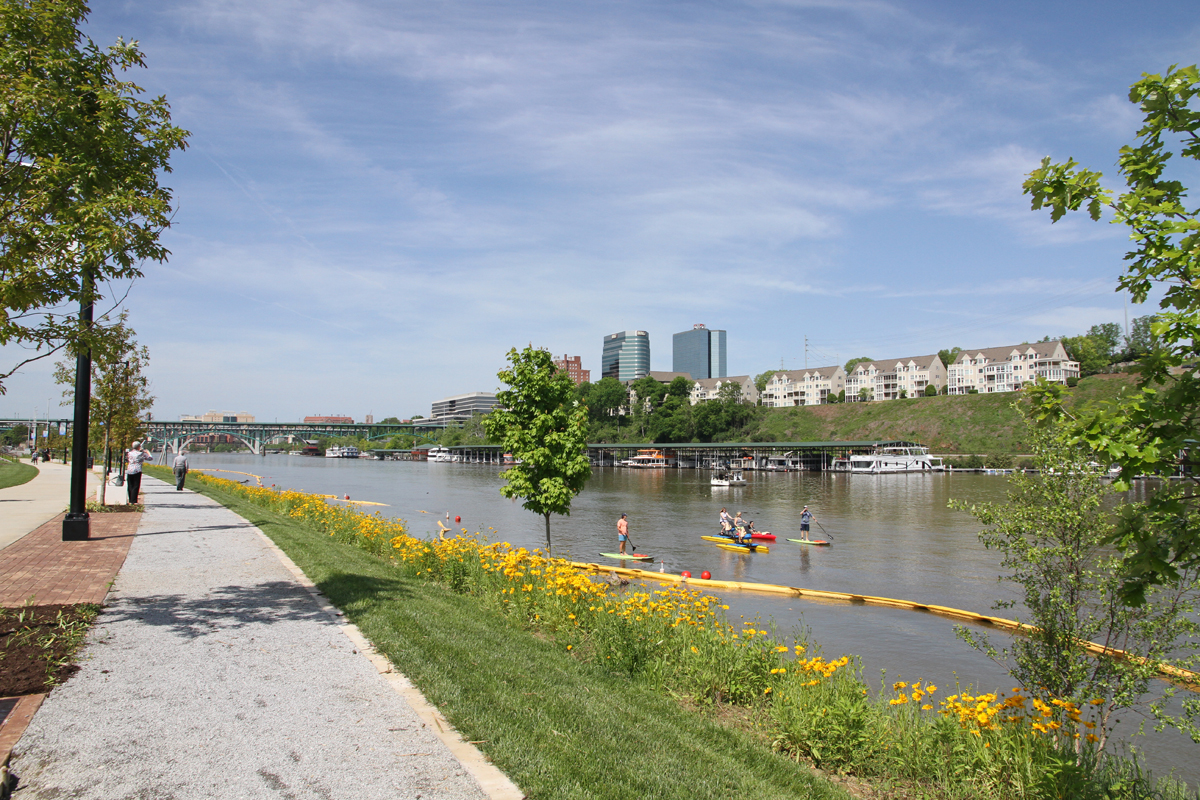 Suttree Landing is among the South Knoxville waterfront locations that will be connected via an ambitious city streetscaping project. Courtesy City of Knoxville
Walk it out: Knoxville plans $10m in streetscape, transportation improvements along Tennessee River in SoKno
The city announced March 24 it will soon embark on part of an ultimately $10 million project to improve walkability and pedestrian safety in the burgeoning South Knoxville waterfront community.
The improvements aim to better connect Sevier Avenue with the waterfront, and include sidewalk construction on main neighborhood streets, better lighting and curb and drainage work near Suttree Landing Park, according to a release from the city. It’s part of a long-term plan to install and improve sidewalks and bike lanes and generally make the area less dependent on automobiles. Aesthetic improvements such as the relocation of overhead utilities are also planned.
“Connectivity and walkability on and near the South Waterfront are important,” said city Deputy Chief of Economic and Community Development Rebekah Jane Justice. “Here on Waterfront Drive, a privately-developed apartment community is planned, but these public sidewalks and other upgrades will benefit the entire community. It’s a step in the right direction toward making it easier for pedestrians to get between Suttree Landing Park and Sevier Avenue,” Justice said in a press release.
“In the coming few years, the city will be investing $10 million in a streetscape overhaul of Sevier Avenue – relocating unsightly overhead utility lines and adding bike lanes, improved sidewalks, street lighting, on-street parking and a new roundabout at the Sevier Avenue, Island Home Avenue and Foggy Bottom Street intersection,” according to the release.
Here’s the rest of the announcement from the city:
“By the end of the year, new sidewalks will be constructed on sections of Waterfront Drive, Langford Avenue, Dixie Street and Empire Street – a $733,263 project that also will add new streetlights and drainage, curb and utility upgrades in the area near Suttree Landing Park on the South Waterfront.
Knoxville City Council last evening on March 23 authorized Mayor Indya Kincannon’s administration to execute an agreement with Design and Construction Services Inc., the company submitting the lowest, most responsive bid to do the Waterfront Drive Roadway Improvements Project.
Work on Claude and Barber streets in the vicinity will be undertaken as funding becomes available.
This type of project, Justice said, is a good example of the City investing strategically to advance one of Mayor Indya Kincannon’s core priorities – building healthy and connected neighborhoods.
One of those planned private investments is South Banks, an apartment community that Dominion Group hopes to construct by next year off Waterfront Drive.
Connecting the Sevier Avenue commercial corridor with Suttree Landing Park by improving public infrastructure between the two points is a short-term city objective. It’s the first of much more to come.”
High-elevation trail plan proposed near Sylva
WLOS: Mountain property owners wary of trail network between Sylva and Cherokee
Proponents of a proposal to build a high-elevation 35-mile multi-use trail system in Jackson County said it could further fuel growth in the area’s outdoor-recreation industry.
Some people who already own homes and property in the area abutting, for instance, Pinnacle Park in Sylva, fear an influx of strangers who would jam roads trying to access public lands owned by Sylva and Cherokee. Shocker.
The Nantahala Area Southern Offroad Bicycle Association is putting together a concept plan. The group says it would be the highest (3,500 feet) such trail network in the eastern United States.
Bradford pears suck, and a South Carolina county is offering a bounty, dead or alive
WBIR: County bounty offered to rein in common nonnative landscaping trees
Confession: Your friendly neighborhood Hellbender Press editor bought a house for his family that featured rows of well-established Bradford pear trees. While they are not my favorite, are distinctly alien and should be made to leave this world, they provide an effective privacy screen. I’m sure many of you are in the same boat: Why eliminate healthy trees and expose your property? Let ’em ultimately die and rot, I guess. And plant natives elsewhere. WBIR also has suggestions for natives to replace Bradford pears.
Maybe we’ll figure it out, but in the meantime here’s a story about a South Carolina county offering a bounty on Bradfords.
Interestingly, WBIR has posted numerous, unflattering stories about Bradford pears over the last couple of years. Seems they have an editorial grudge. Good. Keep rolling with it.
The days the Earth stood still (Part 1): Covid cleared the air in the lonely Smokies
 Great Smoky Mountains National Park Air Resource Specialist is seen at the Look Rock air quality research station. Courtesy National Park Service
The lack of regional and local vehicle traffic during the pandemic greatly reduced measurable pollution in Great Smoky Mountains National Park.
This is your Hellbender weekend read, and the first in an occasional Hellbender Press series about the effects of the Covid-19 pandemic on the natural world
Great Smoky Mountains National Park shut down for six weeks in 2020 during the Covid-19 pandemic. Recorded emissions reductions during that period in part illustrate the role motor vehicles play in the park's vexing air-quality issues. The full cascade of effects from the pollution reductions are still being studied.
Hellbender Press interviewed park air quality specialist Jim Renfro about the marked reduction of carbon dioxide and other pollutants documented during the park closure during the pandemic, and the special scientific opportunities it presents. He responded to the following questions via email.
Hellbender Press: You cited “several hundred tons" in pollutant reductions during an interview with WBIR of Knoxville (in 2020). What types of air pollutants does this figure include?
- great smoky mountains national park
- coronavirus
- smokies
- pandemic
- air pollution
- covid19
- air quality
- shutdown
- pollutant reduction
- carbon dioxide
- co2
- motor vehicle
- jim renfro
- nox
- voc
- improvement
- haze
- ozone
- look rock
- emission
- greenhouse gas
- visitation
- visitor
- traffic volume
- analysis
- monitoring station
- particulate matter
- mercury
- acid deposition
- quality control
- quality assurance
- so2 regional haze rule
- national park service
- nps
- air resource specialist
- ecosystem
- bioaccumulation
- so2
- road closure
- power plant
- epa
- environmental protection agency
Opponents race to stop proposed motorsports track in Oak Ridge
KNOX NEWS: Does a motorsports park make sense for Oak Ridge?
A Knoxville real estate developer and some officials maintain a motorsports park at the Horizon Center industrial park would create jobs, tax revenues and a destination for private high-performance vehicle enthusiasts in the region. Opponents lament possible noise and light pollution and the loss and fragmentation of healthy, diverse hardwood forest and open space set aside decades ago by DOE as an environmental preserve.
The municipal approval process has moved forward since this video was made, but here is a comprehensive argument from those who oppose the Oak Ridge motorsports park and would rather preserve the popular recreational and natural site on the far west end of Oak Ridge.
Being fire: Volunteers help preserve a classic East Tennessee cedar barren
 A volunteer removes invasive plants from an Oak Ridge cedar barren as part of a Tennessee Citizens for Wilderness Planning effort to keep the barren in its natural prarie state. Anna Lawrence/Hellbender Press
Volunteers play the part of fire to maintain the native grasses and wildflowers at an Oak Ridge cedar barren
OAK RIDGE — It’s called a barren, but it’s not barren at all. It’s actually a natural Tennessee prairie, full of intricate, interlocking natural parts, from rocks and soil to plants and insects and animals.
There’s lots of life in these small remaining unique collections of grasses and conifers that are typically known, semi-colloquially, as cedar barrens.
Many of these “barrens” have been buried beneath illegal dumping or asphalt, but remnants they are still tucked away here and there, including a small barren in Oak Ridge owned by the city and recognized by the state as a small natural area.
First Native American named to lead Department of the Interior
NYT: Interior Secretary first Native American to hold vital post
The Senate on March 16 confirmed the first Native American director of the U.S. Department of the Interior, Democratic U.S. Rep. Deb Haaland of New Mexico.
“… her new position is particularly redolent of history because the department she now leads has spent much of its history abusing or neglecting America’s Indigenous people.
“Beyond the Interior Department’s responsibility for the well-being of the nation’s 1.9 million Native people, it oversees about 500 million acres of public land, federal waters off the United States coastline, a huge system of dams and reservoirs across the Western United States and the protection of thousands of endangered species.”
Tennessee journalists wary of amendments to public meeting laws
ETSPJ: Hold up on Covid-era meeting law changes to ensure public accommodation
Hellbender Press takes a fundamentalist attitude when it comes to the First Amendment and unimpeded public access to information from the government and its decision-making processes. The East Tennessee Society of Professional Journalists released a statement March 12 regarding public access problems with an otherwise reasonable amendment to the state open-meetings laws. The amendments were introduced at the request of the Knox County Commission, according to ETSPJ.
Here is the press release from ETSPJ in its entirety:
“The East Tennessee Society of Professional Journalists opposes a bill sponsored by two Knoxville lawmakers, Rep. David Wright and Sen. Richard Briggs, that would create yet another exemption to the state Open Meetings Act.
The bill, apparently introduced at the request of the Knox County Commission, would allow almost half the members of a county legislative body to participate in meetings by telephone or other electronic means. For Knox County, this would mean four of the nine commissioners; for Davidson Metro Council with 40 members, 19 of them could conceivably participate by telephone.
The rationale for the bill is laudable in that so long as a quorum is physically present in a single location, it permits an otherwise absent member to attend and represent constituents. Acceptable reasons for absence are family or medical emergencies, military service or out-of- the-county work.
Its shortcoming, however, is the total lack of public accommodation. As currently drafted, this bill would be an exception to a section of Tennessee law that permits such electronic participation so long as all conversation is audible to the public, each member can simultaneously hear and speak to each other during the meeting and all votes are taken by roll call.”
The requirements in the existing Tennessee law are similar to those in the governor’s emergency executive order for public meetings during the pandemic, but the Briggs-Wright bill would incorporate the convenience of the pandemic order for government officials without any of the public safeguards.
Tennessee school boards received an exemption in 2012 for electronic participation, but whether by happenstance or by local rule, the Knox County School Board has never had more than one member participate electronically at the same time. So, the public has not faced the obstacle of determining who is speaking or how members participating by telephone voted.
The exemption to existing law for school boards may have begun a slippery slope for multiple state governing bodies to carve out a permanent exemption in the state Open Meetings Act.
ETSPJ asks that lawmakers Briggs and Wright withdraw their bill or else amend it so that it incorporates public accommodations similar to those in the existing state law and the governor’s executive order for meetings during the pandemic.
Indigenous people could provide a path to global land and water preservation
NYT: Global effort under way to protect 30 percent of the world’s remaining natural areas
The “30x30” plan, led by Britain, Costa Rica and France, aims to preserve at least 30 percent of the Earth’s remaining natural terrestrial and aquatic habitats. A convention of dozens of nations in China later this year will outline and streamline possible methods to meet this goal. Some countries want to increase the goal to 50 percent.
One good reference point may be the lands controlled by indigenous people, who, research shows, do a remarkably good job of maintaining biodiversity in the native habitats in which they live. Their careful methods of resource extraction provide economic benefits while preserving the natural integrity of their native lands.
The U.S. is the only country aside from the Vatican to not agree to the convention’s goal, though President Joe Biden has floated a similar plan to preserve 30 percent of the country’s remaining natural areas.