
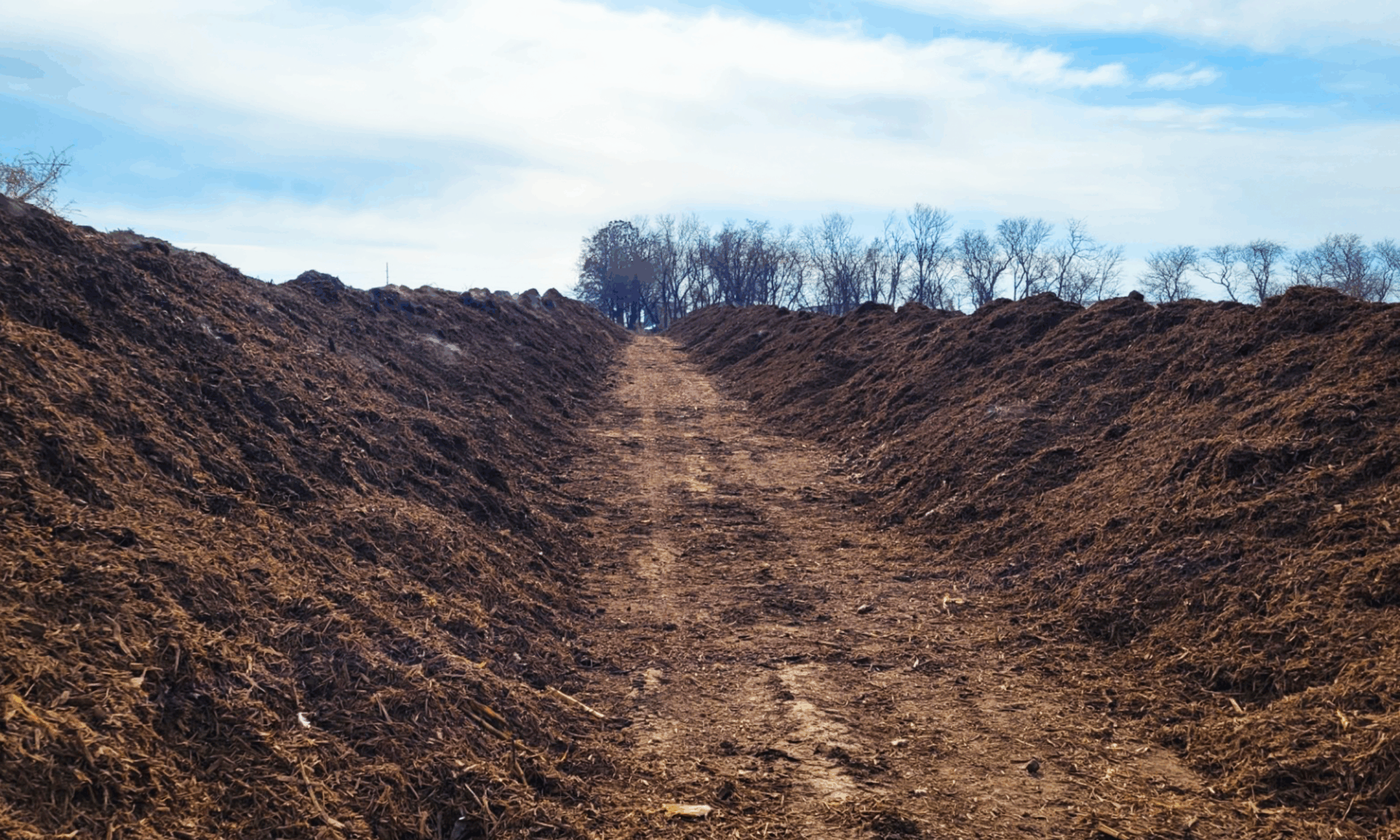
 Maintaining safe temperatures and moisture levels within compost piles often requires labor-intensive manual testing processes. An AI-powered monitoring network under development at the University of Tennessee Institute of Agriculture will improve safety oversight. Photo courtesy UTIA.
New AI robot sensor network will improve composting safety and efficiency
Tate Cronin is a UTIA marketing and communications specialist.
KNOXVILLE — Composting turns organic waste into nutrient-rich material, but improper temperature and moisture control can allow pathogens to survive and increase safety risks. Researchers at the University of Tennessee Institute of Agriculture (UTIA) and UT Knoxville received a $362,000 grant from the Center for Produce Safety to develop an automated sensor network to improve monitoring of compost piles.
Sensors will be developed for placement directly within piles, eliminating the need for labor-intensive manual testing processes. Aerial drones equipped with radio-frequency identification (RFID) and light detection and ranging (LiDAR) technologies will collect data from the new sensors, mapping precise locations of temperature and moisture variations. Machine learning algorithms will then analyze the data, displaying information on a digital dashboard to help compost operators improve turning schedules and ensure uniform heating.
Chetan Badgujar, project lead and agricultural engineer in the Department of Biosystems Engineering and Soil Science, says the new system will support data-driven decision making. “Cold spots within a compost pile allow harmful pathogens to survive, while hot spots increase combustion risks. Our battery-free sensors will cost approximately $4 each, almost 90% cheaper than existing automated solutions. We want to save composters time and money in their day-to-day operations while still meeting FDA standards for safety.”
