
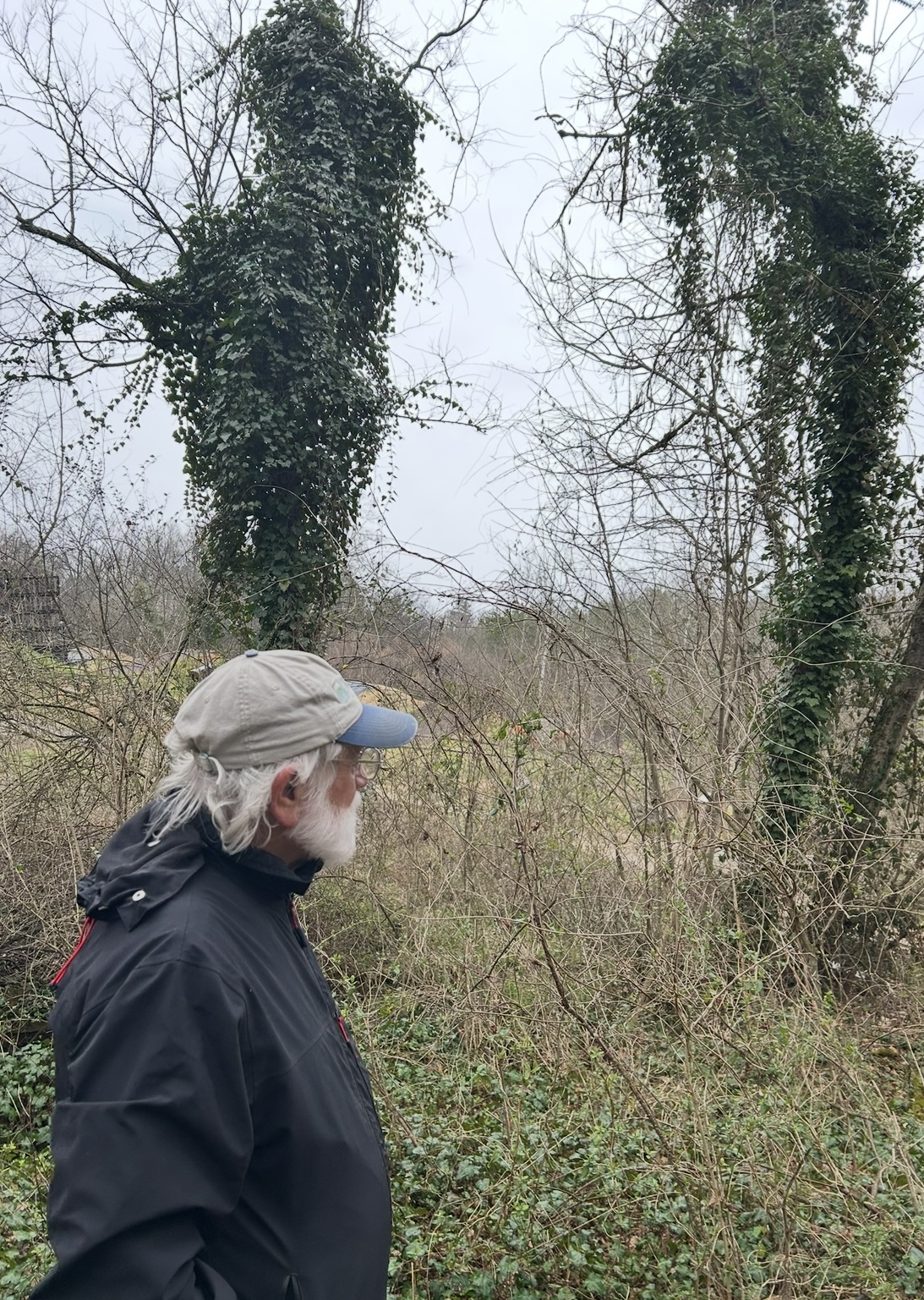
“This stuff is going everywhere," Nolt said on a damp morning in early March as he stripped several feet of vines from one trunk. He identified it as English ivy and wintercreeper, which seemed to be growing in tandem on dozens of trees only a stone’s throw from the Baker Creek parking lot.
“I first noticed it two years ago,” he explained. “At first I hadn't seen it top trees like this, but the news is that it's now topping and actually killing a bunch of trees.”
Nolt would like to see many more people willing to tackle this problem, and he may soon get his wish.
According to Ben Epperson, Quarry Coordinator for the City’s Office of Urban Design and Development, a significant effort to bring the invasive species under control is about to get underway.
“Our access to nature through the Urban Wilderness is something that's unparalleled in other cities,” said Ben Epperson,. “At the same time, our green spaces are being inundated and invaded with these opportunistic species.”
Epperson is quick to point out that the non-native vegetation is simply doing what all life forms are compelled to do — compete and thrive .
“The problem is that these plants love it here so much that they multiply at a rate greater than a lot of our native species,” he said. “What’s happening is this privet and this honeysuckle is out-competing all of those little niche plants that make our biodiversity so world-class: the ephemeral spring flowers, the native warm season grasses, the understory wildflowers. Now, when you look around our woods in the springtime, instead of all those beautiful wildflowers what you're seeing is this neon green privet and honeysuckle.”
He added: “It’s not altogether a bad thing. These plants aren't choosing evil. They are finding a niche, and they're filling it, which is what the Earth does. That's what life does — it finds an empty spot, and it fills it. And these empty spots are there because of us. They are there because of human disturbance.”
Epperson stressed that controlling the spread of these invasive species isn’t a question of aesthetics. It’s necessary, he said, to protect the health of East Tennessee’s native forests and all the creatures that depend on them.
“It’s not just about unsightliness,” he stated. “It’s about helping to rebalance the ecosystem that has been thrown out of balance. When we think of nature, we think of trees and flowers as well as birds and bees. You know, that’s the flora and fauna of the wilderness. The fauna — the animals, invertebrates, arthropods, butterflies, bees, beetles, songbirds, and all the other animals — are part of a food web, and at the base of this food web is our native plants.”
He continued: “Those creatures don't feed on invasive species. As the invasive species spread, we have less and less of our native biodiverse species, which means that our food web begins to crumble. If left unchecked, when you go outside you will hear fewer songbirds, you will see fewer bees and butterflies, and you will see fewer large mammals.”
To combat the problem, City officials have formed an Invasive Species Strike Team under the Office of Urban Forestry. The team is made up of several city departments and local organizations that are focused on access to green space, according to Epperson. .
They hope to rally groups of volunteers who are willing to tackle the non-native flora with a combination of tools, herbicides, and muscle.
They’re also counting on the partnership of organizations like Ijams Nature Center and the Sierra Club, which can mobilize equipment and a further reservoir of willing workers.
“There are organizations like Ijams that have been doing this kind of thing for years,” said Epperson. “They have a volunteer coordinator, groups of volunteers, and monthly weed wrangles. “We’re trying to match their model. Anything we can do to support them, to learn from them, or to contribute to their efforts is going to benefit our efforts as well. We see ourselves as kind of standing shoulder-to-shoulder as we address this issue.”
With luck and perseverance, he stressed, the spread of non-native flora will hopefully be brought under control before it causes irreversible damage the local ecosystem.
“We need to work together to chip away at this problem,” Epperson said. “It's not something that will happen overnight, and it's not something that can be eradicated in a day. But it’s very satisfying to work alongside your friends and neighbors, pulling up these giant privet bushes with your bare hands using a weed wrench.”
Officials are in the process of scheduling a series of volunteer days, and Epperson has asked anyone interested in taking part to contact him by phone at 865-604-6431 or by sending an email to This email address is being protected from spambots. You need JavaScript enabled to view it..
“What we would really like to see over time is a friends group that's dedicated to invasive species management and eradication,” he said. “So we’re actively trying to build that out right now. We’re in our baby steps.”
https://www.knoxvilletn.gov/