
Displaying items by tag: conservation fund
More land comes together for Hatchie Bottom conservation
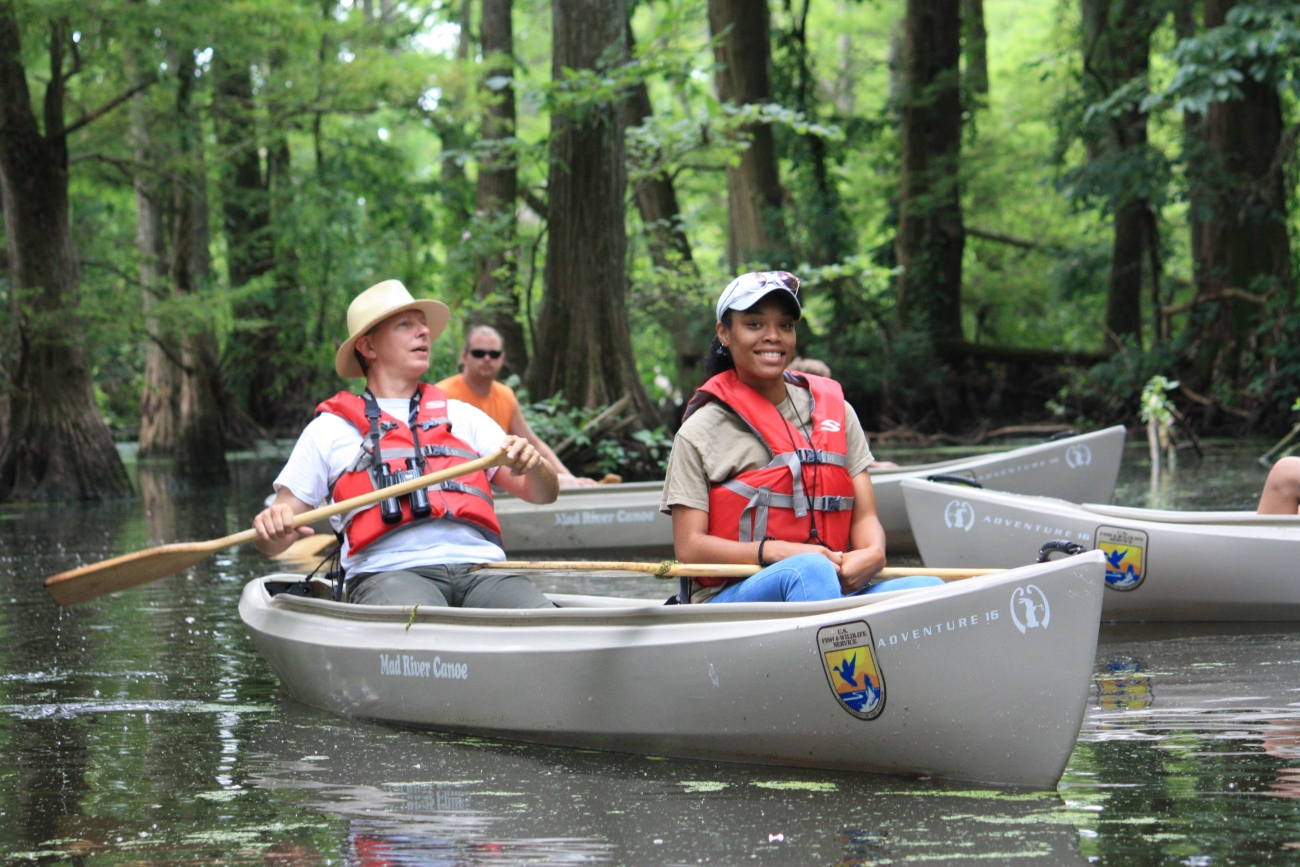 Canoeists enjoy a paddle along the Hatchie River in West Tennessee. A recent land acquisition brings the total of bottomland protected in the river corridor to 37,000 acres. U.S. Fish and Wildlife Service
Hatchie Bottom property will join more than 30,000 acres of protected lands along river corridor
Lee Wilmot is a public information officer for the Tennessee Wildlife Resources Commission.
NASHVILLE — The Tennessee Wildlife Resources Agency in partnership with The Nature Conservancy of Tennessee (TNC) and The Conservation Fund (TCF), announced the acquisition of the Hatchie Bottom property, a 7,457-acre expanse of ecologically rich bottomland hardwood forest along the Hatchie River.
The acquisition represents a major milestone in Tennessee’s Conservation Legacy initiative and fulfills a longstanding priority in the Tennessee State Wildlife Action Plan to protect and preserve critical wildlife habitat. The property will be managed as a new wildlife management area (WMA), and will also provide new opportunities for hunting, fishing, wildlife watching, and outdoor recreation.
“The Hatchie Bottom acquisition is a powerful example of what we can achieve when conservation partners come together with a shared vision for Tennessee’s natural heritage,” said Gov. Bill Lee. “This acquisition reflects our commitment to safeguarding the state’s most treasured landscapes while expanding opportunities for Tennesseans to connect with the outdoors. It’s an investment in our environment, our communities, and the generations to come in the Volunteer State.”
Pending state conservation deal would protect forest and water resources
 A man paddles down the main stem of the Wolf River in West Tennessee. The state is working to purchase 5,477 acres of forest land near Grand Junction from the Hobart Ames Foundation. The land is part of the Wolf River watershed. Wolf River Conservancy
The roughly 5,500-acre property features wetland forest used for research by the University of Tennessee
This article was originally published by Tennessee Lookout.
GRAND JUNCTION — About 60 miles east of Memphis near the Mississippi line, verdant hardwood trees and ecologically exceptional streams weave through thousands of acres of rolling hills.
The land is home to a diverse array of aquatic and terrestrial life, decades-old archaeological sites and a watershed that feeds into the aquifer where hundreds of thousands of Memphians source their drinking water.
If all goes to plan, 5,477 acres of this land will soon become Tennessee’s newest state forest, securing its preservation for posterity.
The land is a portion of the 18,400-acre historic Ames Plantation, a privately owned tract in Fayette and Hardeman Counties amassed by Massachusetts industrialist Hobart Ames in the early 1900s.
- memphis aquifer
- memphis drinking water
- land conservation
- west tennessee land preservation
- drinking water protections
- cassandra stephenson
- tennessee lookout
- conservation fund
- ames plantation
- wolf river
- wolf river conservancy
- ut ag research
- hobart ames foundation
- tennessee state forests
- state forests in tn
- grand junction, tennessee
- ford blue oval
- heritage conservation trust
- forest service legacy program
Another slice of the wild preserved in Cumberlands
Knox News: Nearly 12,000 acres added to Skinner Mountain preserve on the Cumberland Plateau
The Conservation Fund and state wildlife and forestry officials reached a deal to conserve and manage thousands of wild acres in Fentress County.
The expanse was previously held by an out-of-state speculative investment company likely originally tied to timber companies.
The Cumberland Plateau and escarpments have been increasingly recognized for their biodiversity along with the Smokies to the east beyond the Tennessee Valley. The Cumberlands are along a songbird and fowl migration route, and host a niche population of mature timber, mosses, lichens, fungi, mammals and amphibians. Elk were reintroduced a decade ago, and black bears have begun to range across the Cumberlands and their base.
The area is pocked with caves and sinkholes, some containing petroglyphs and other carvings from previous populations.
"On the Cumberland Plateau, the key to maintaining biodiversity is to retain as much natural forest (both managed and unmanaged) as possible," a forestry expert told the News Sentinel's Vincent Gabrielle.
The Foothills Land Conservancy has also helped protect thousands of acres along the plateau and its escarpments in recent years.